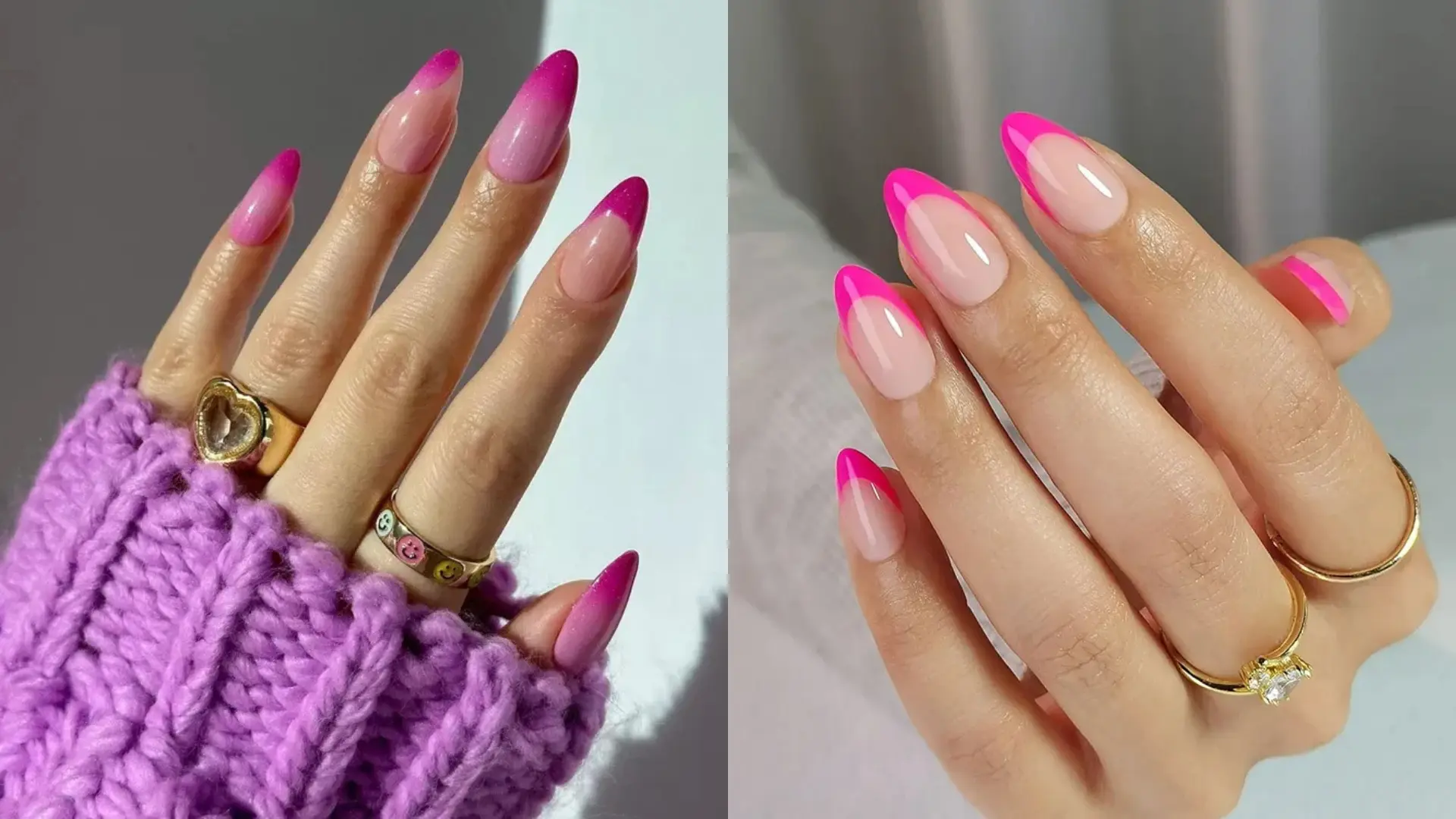
Red French Tip Nail Designs: 66 Ideas for Every Shape & Shade (2026)
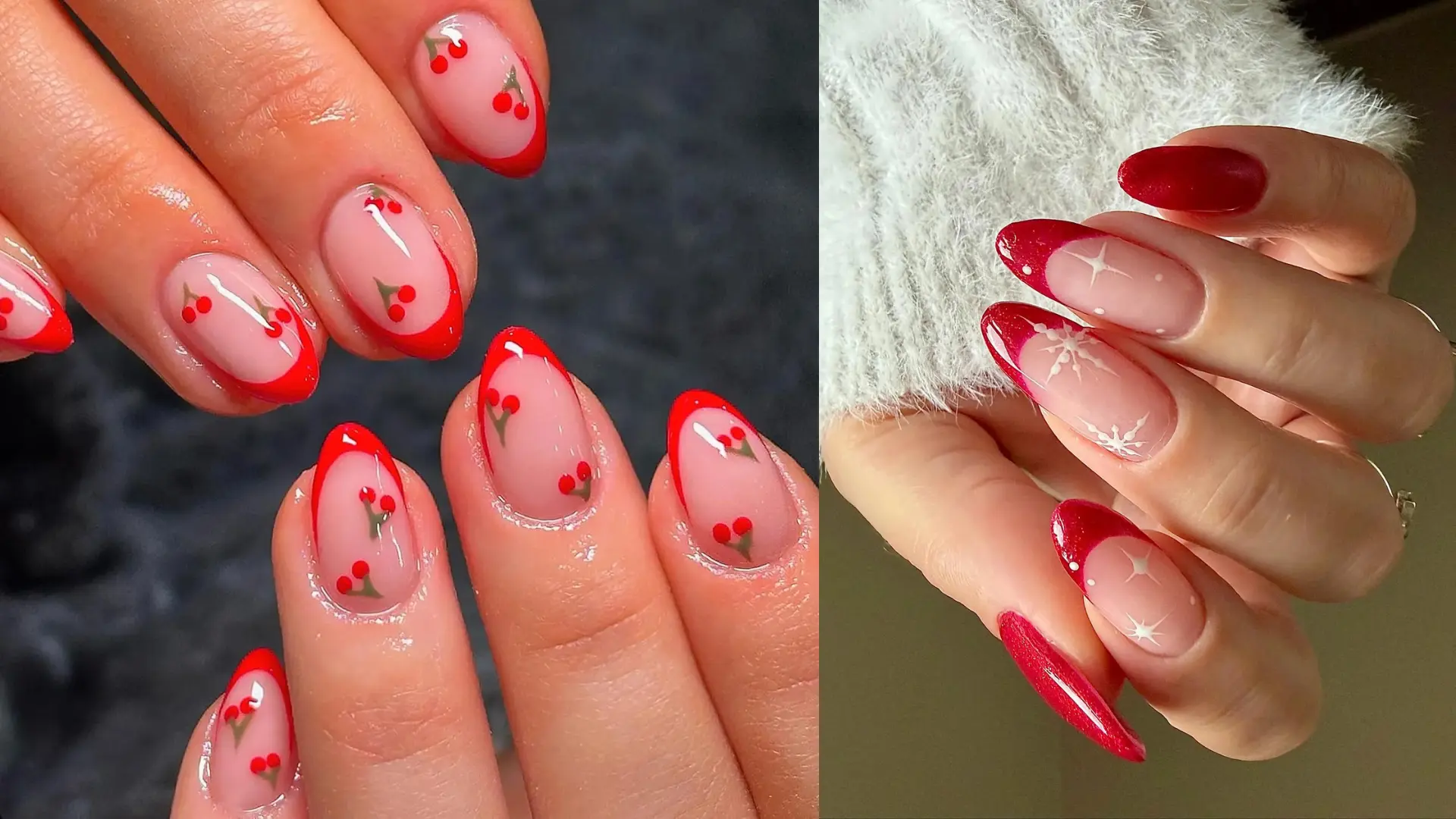
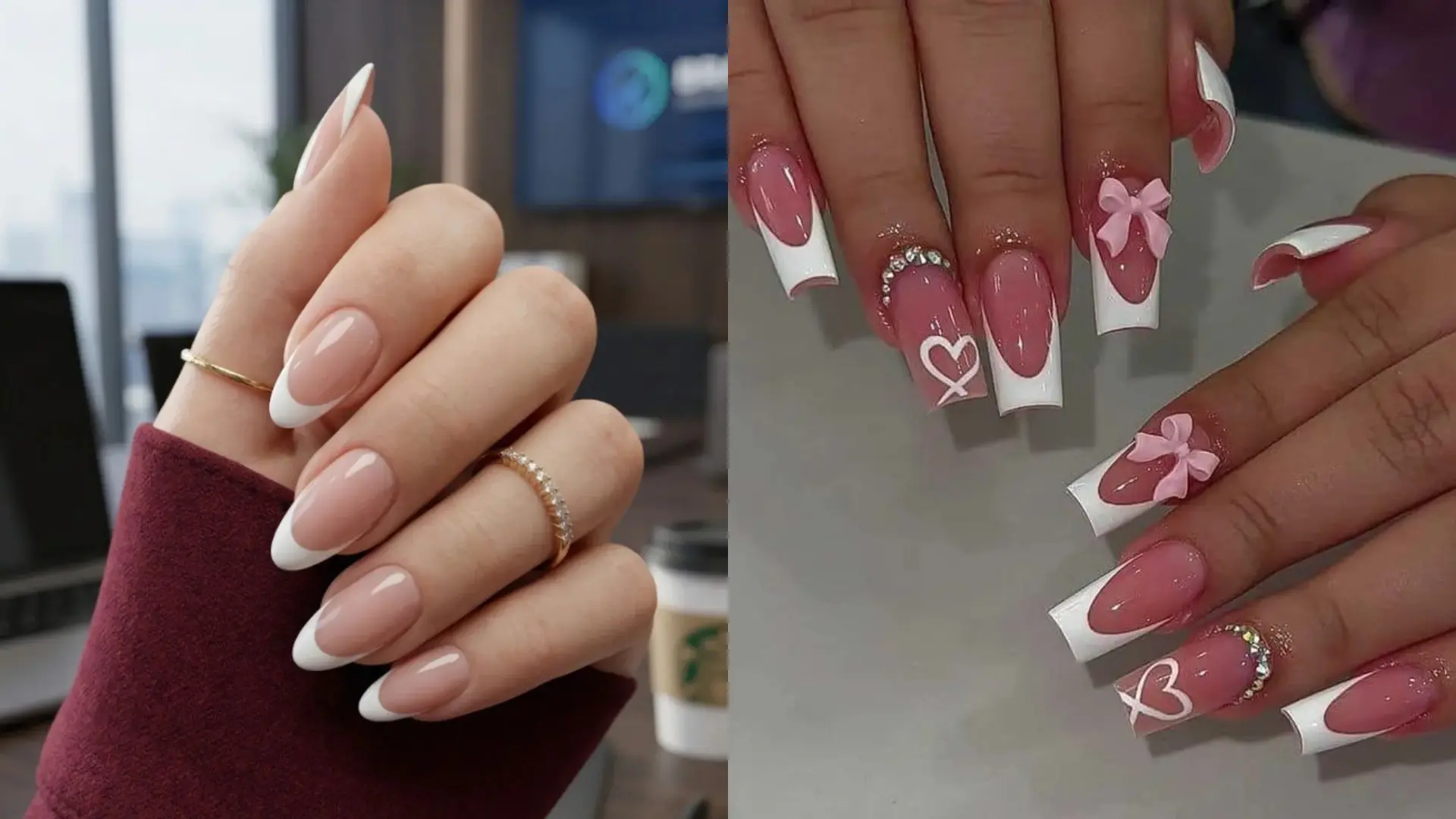
Red French tips swap the classic white tip for red. You keep the clean lines of a French manicure, but add the warmth and confidence of red polish.
The look is having a real moment. Two trends are driving it: the French manicure revival and red nail theory. Red nail theory is the viral idea that red nails read as confident and attention-getting. Together, they’ve kept red French tips near the top of nail searches through 2026.
A red French tip manicure keeps a bare or sheer base and paints just the tip, or free edge, in red, unlike a classic French manicure, which uses white for that tip.
This guide covers every version of the red French tip nail design, from classic and reverse to chrome, glitter, and hand-painted styles. You’ll also find guidance on picking a flattering red, choosing a base, and doing the look at home.
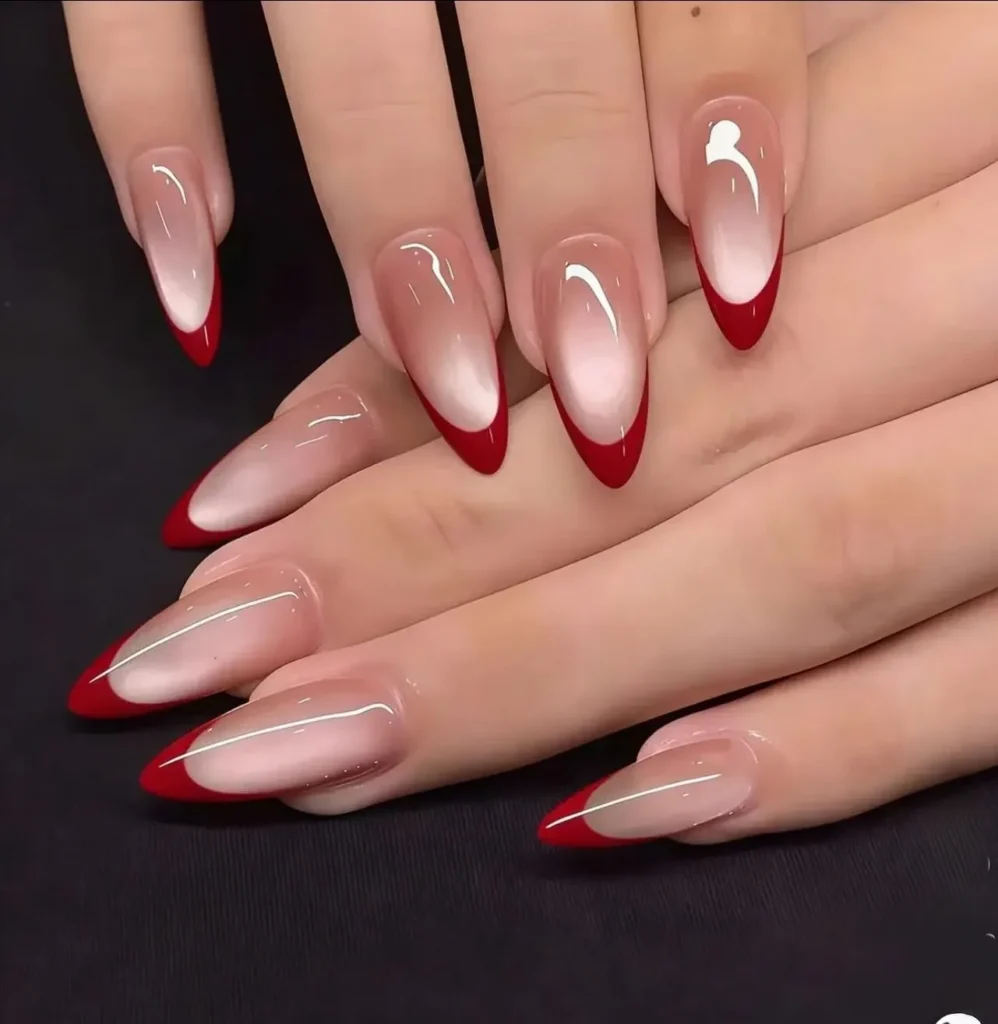
Editor’s Note: Nailinspo.pro curates real nail inspo from working nail artists. Every design here comes from an artist our team has personally verified. We do not use AI-generated images, and we do not pull from anonymous or unverifiable sources.
Our team checks each artist’s page for consistent, real work before featuring them. We may earn a commission on some links at no cost to you. Learn more on our About page.
Classic & Minimalist Red French Tip Nails
These seven styles strip the look down to its simplest form. No embellishments, no chrome, no nail art. Just clean color and shape, which makes them the easiest entry point if you’re new to red French tips.
1. Classic Red French Tip
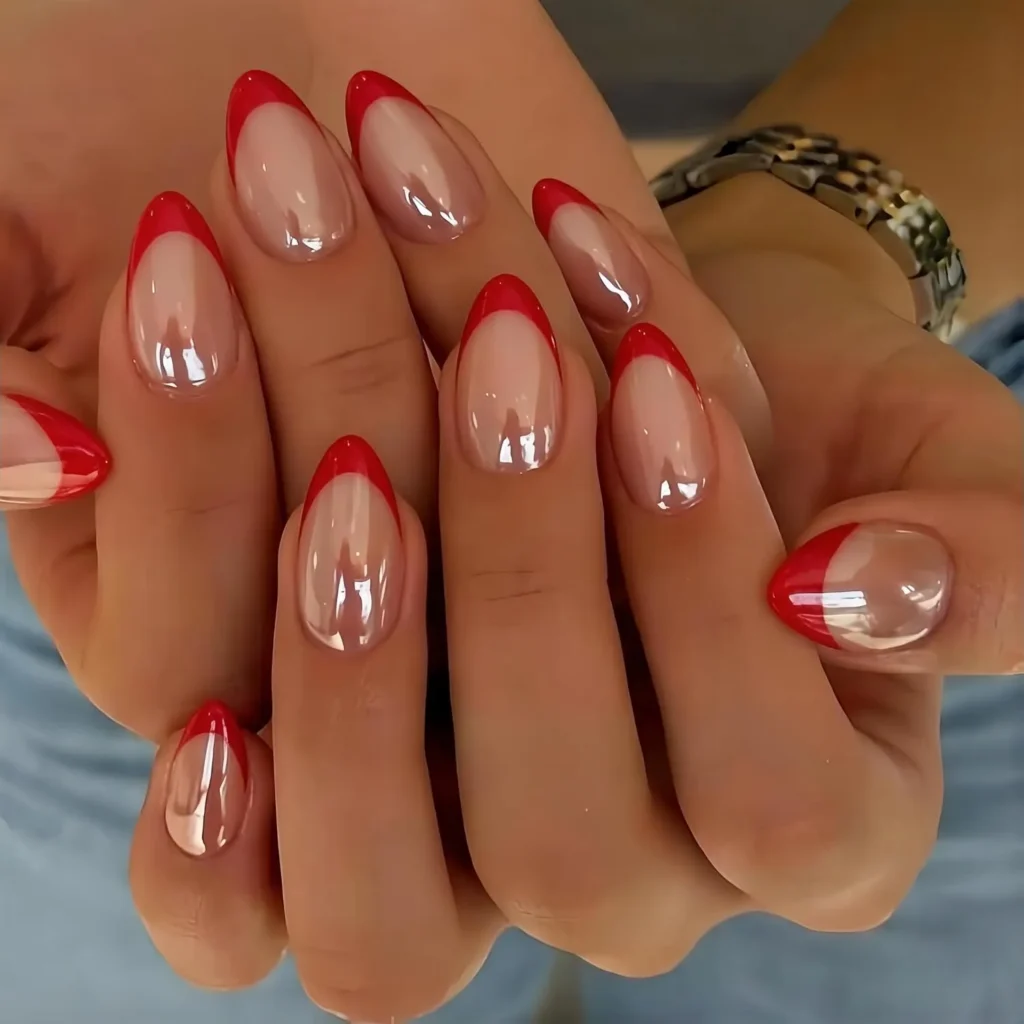
This is the original swap: a sheer pink or nude base with a medium-width red tip in a soft, curved smile line. It works on almost any nail length or shape, which is why it’s the version most people picture when they hear “red French tip.”
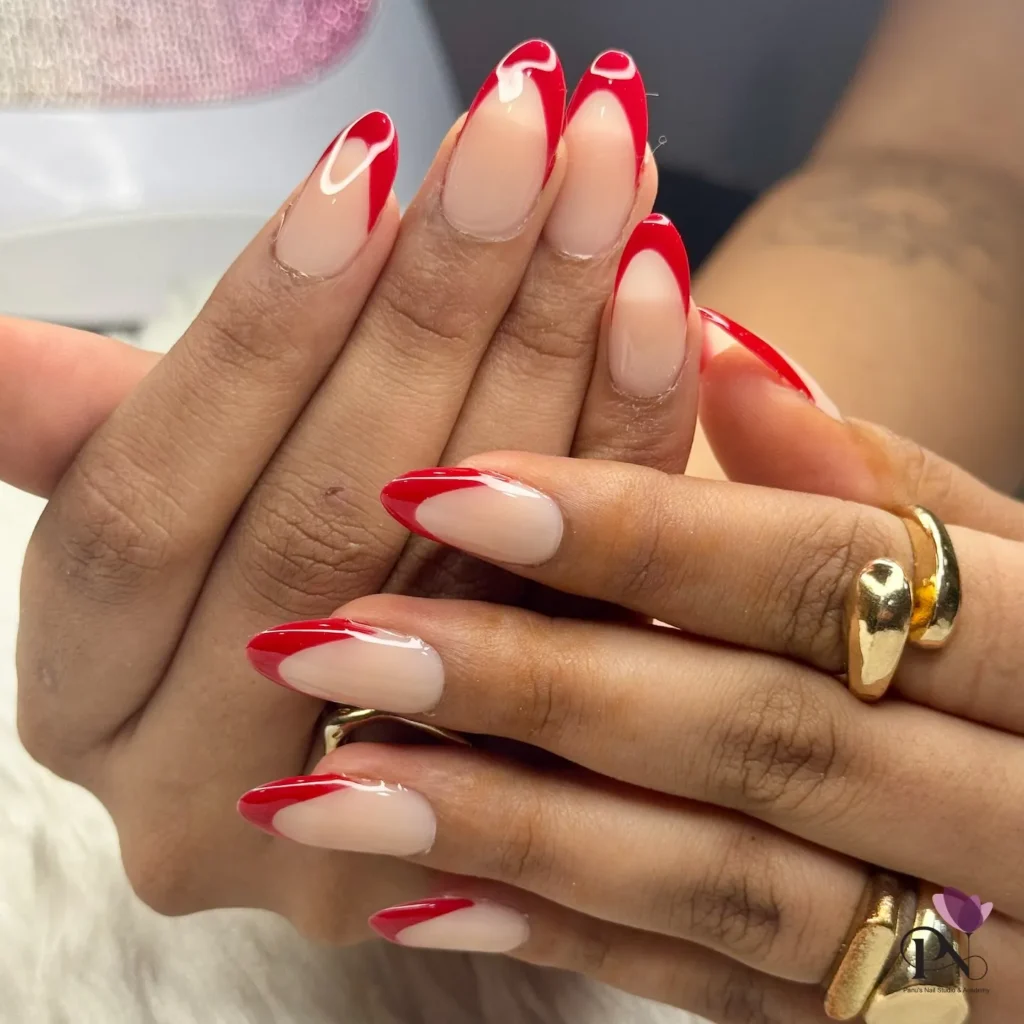
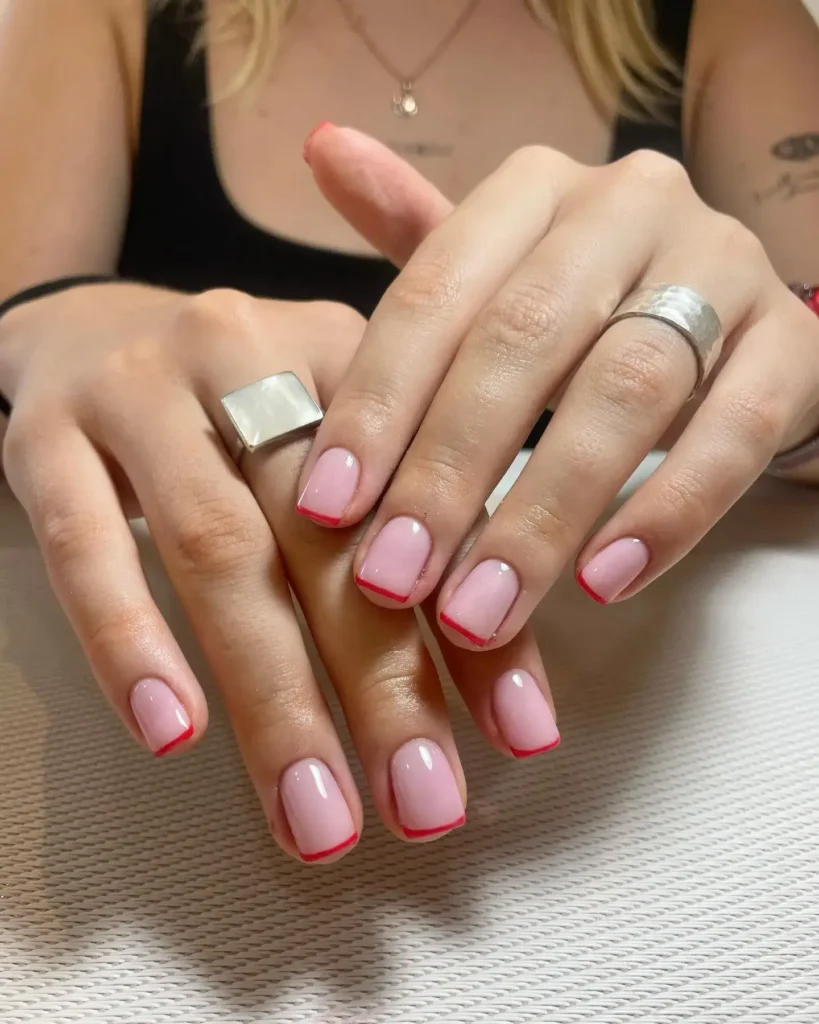
2. Micro French (Thin Red Tip)
The tip here is barely a millimeter wide, just a hairline of red along the very edge of the nail. It keeps most of the natural nail visible, which makes it a good choice for offices or anywhere a full red manicure feels like too much.
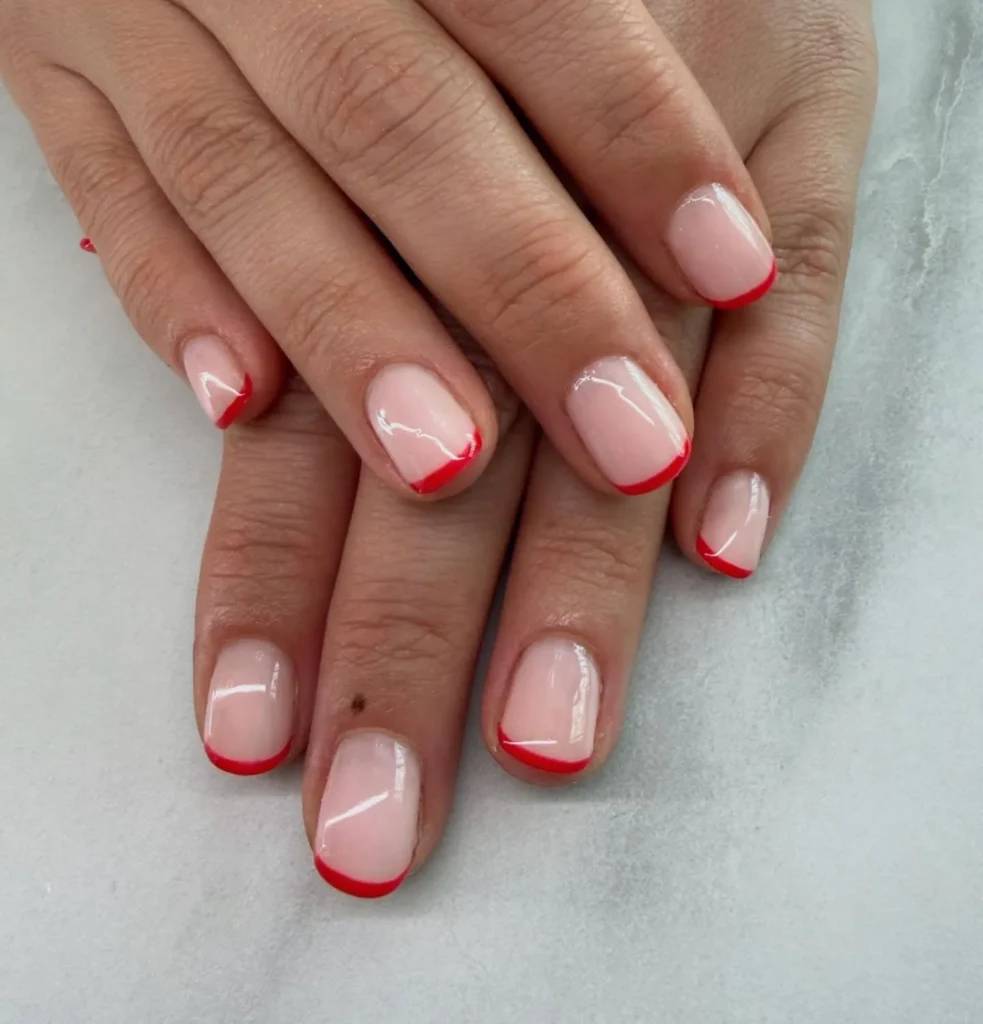
3. Deep French (Wide Red Tip)
This version pulls the red line much lower, covering close to half the nail. It’s a callback to late-90s and early-2000s French manicures, and the extra color makes shorter nails look longer.
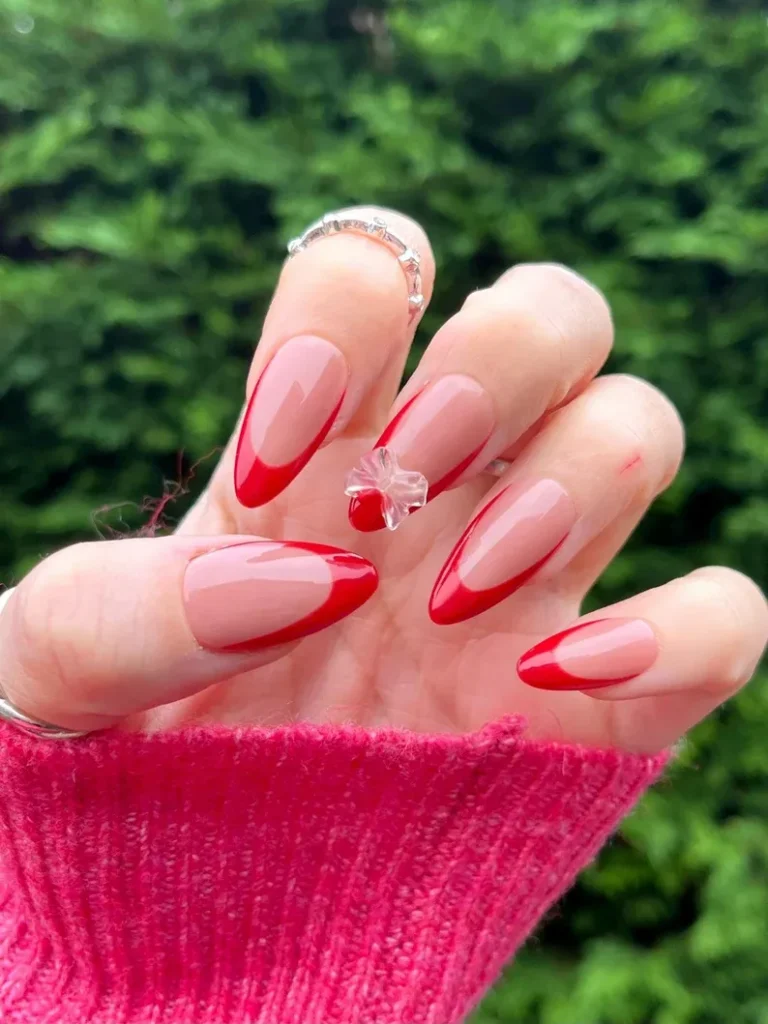
4. Simple Crescents
Instead of a straight or curved band, the red sits in a small half-moon shape right at the very tip. It reads as delicate and works especially well on short, rounded nails.
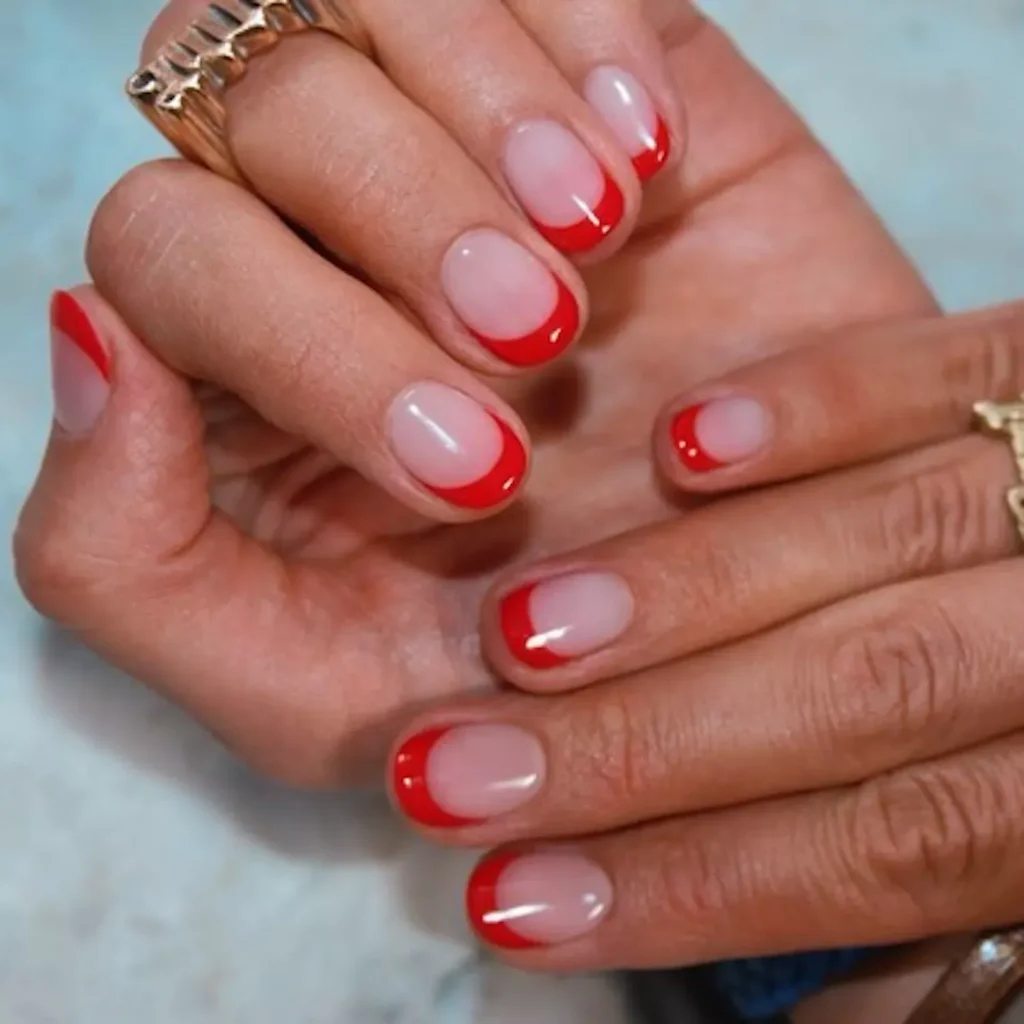
5. Bright and Cheery Red Tips
This style keeps the classic French shape but leans into a true, high-saturation red instead of a deeper wine or cherry shade. It’s the pick for anyone who wants the design to feel upbeat rather than moody.
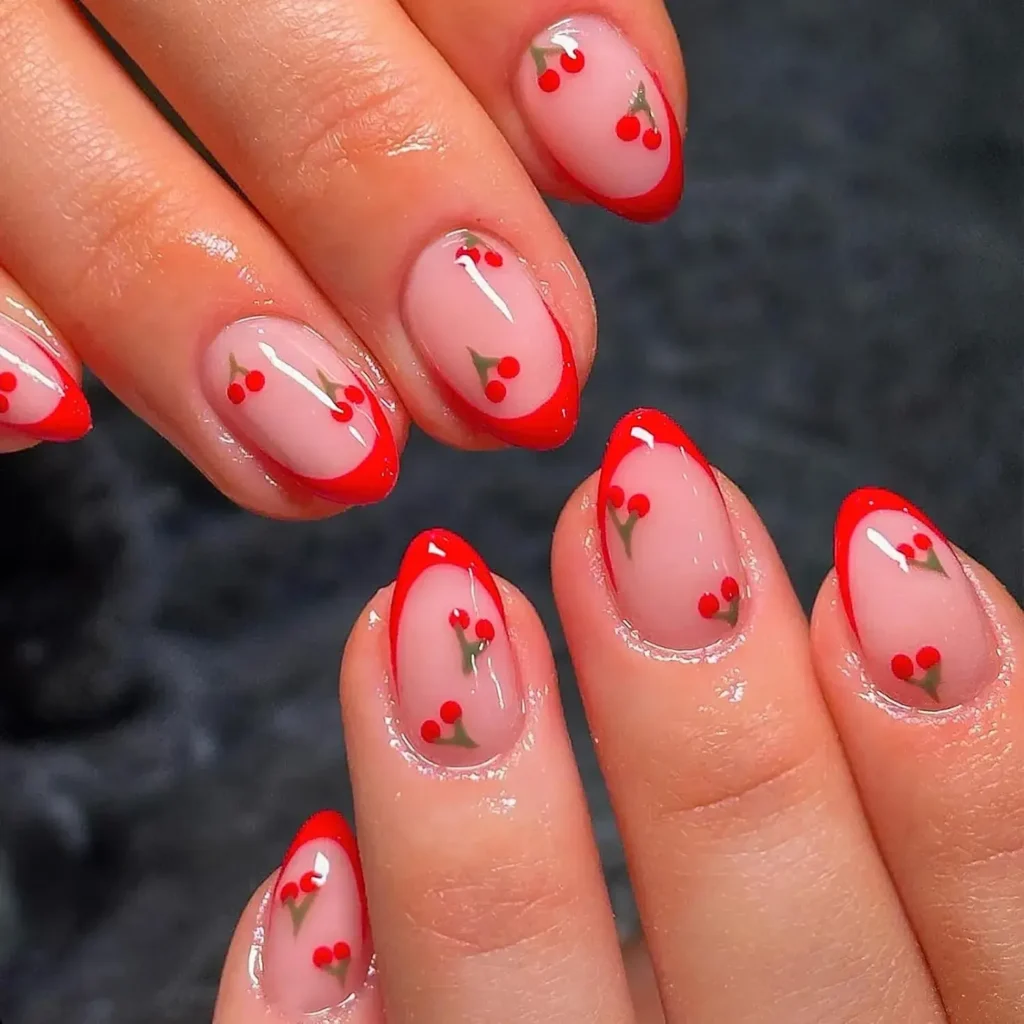
6. Thin French Tips
A step up from micro French in width, this keeps the tip narrow but still clearly visible as a line rather than a hairline. It suits longer nails where a wider tip would look heavy.
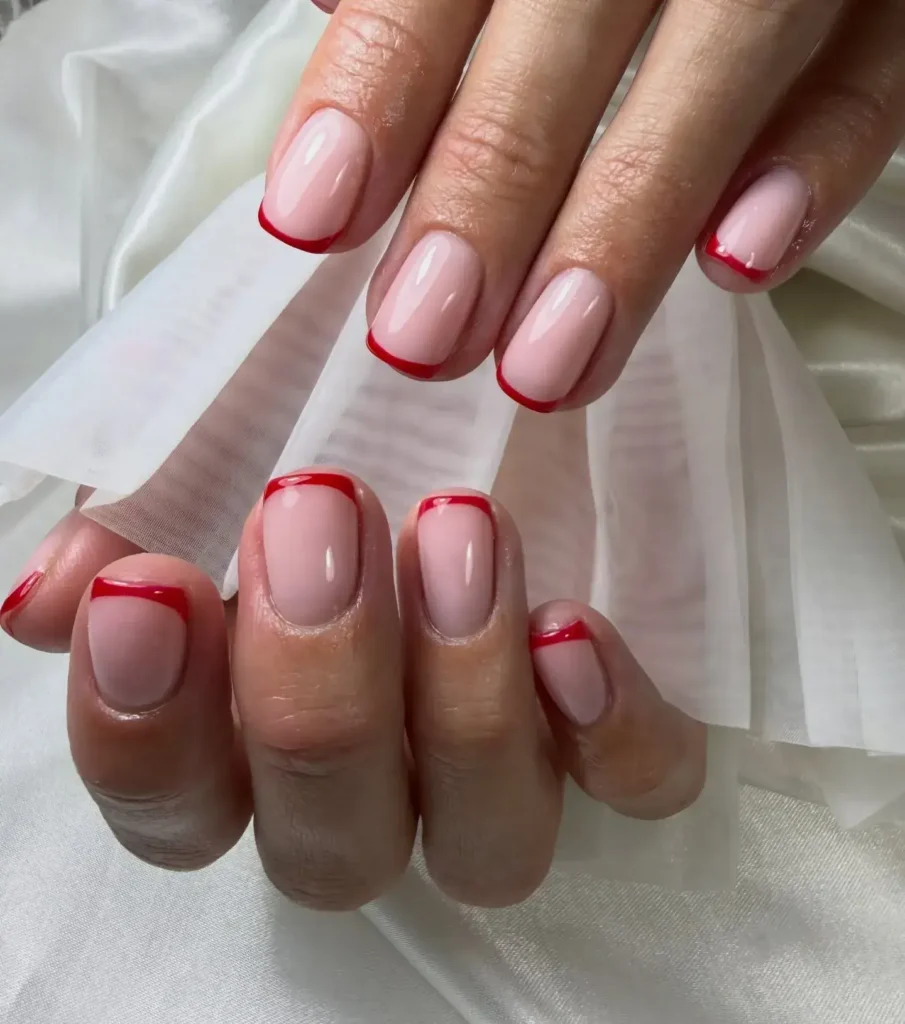
7. Simple French
This is the no-frills, everyday version: a standard-width tip, a plain nude base, and a glossy top coat. No extra shade blending or detail work, which makes it the fastest style to recreate at home.
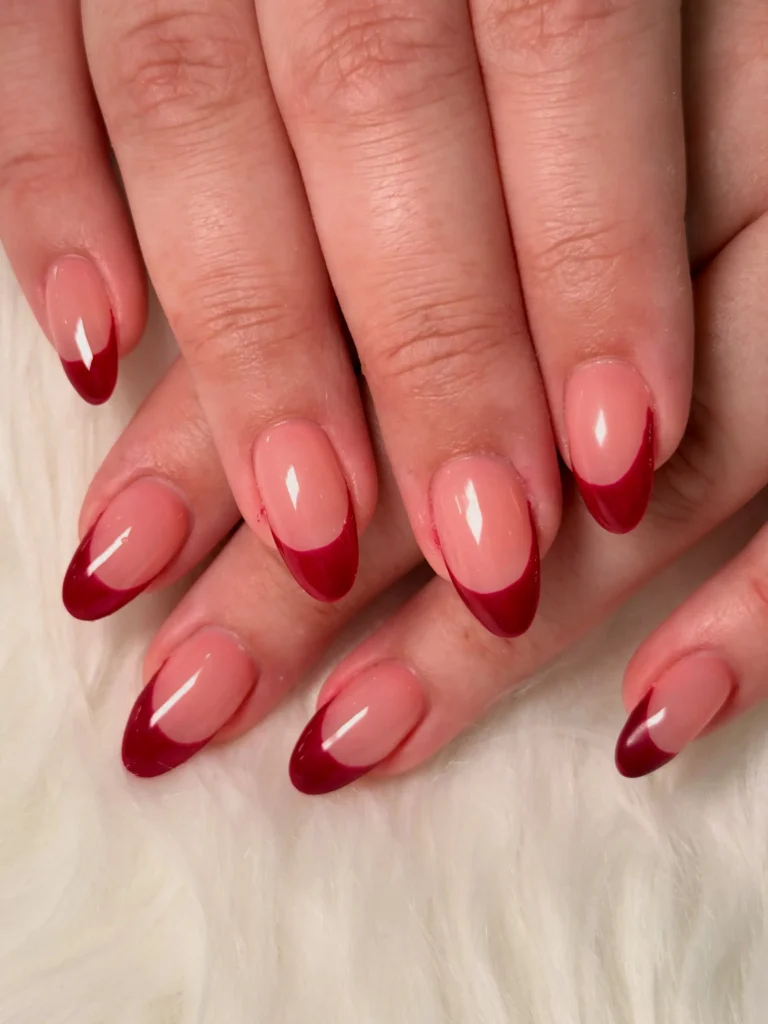
Reverse French & Color-Blocked Designs
These six styles move the red away from the traditional tip position, or split the nail into two colors instead of one. They give the French manicure format a bolder, more graphic feel.
8. Reverse French (Red Base, Nude Tip)
This flips the classic format. Red covers the nail near the cuticle in a curved band, and the tip stays bare or sheer. It puts the color where your eye lands first when you make a fist, which makes it read as bolder than a standard red tip.
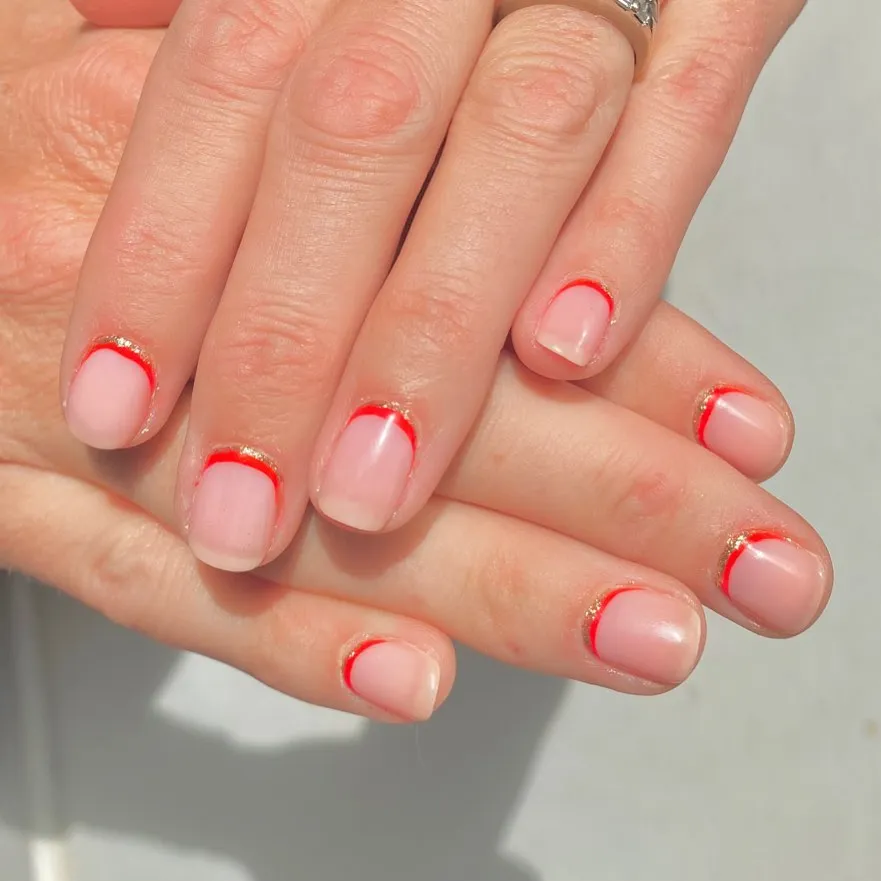
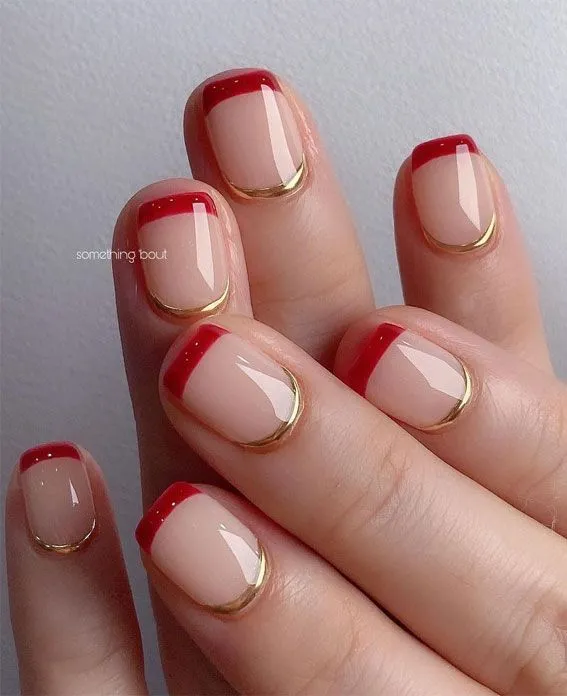
9. Half-Red, Half-Gold
Each nail splits down the middle, with red on one side and metallic gold on the other. It works best on longer nails, where there’s enough surface area for both colors to read clearly.
10. Bold Color Block
Instead of a French line, the nail is divided into solid blocks of red and one or two other colors, often pink or nude. There’s no blending or gradient. Each section stays a flat, distinct color.
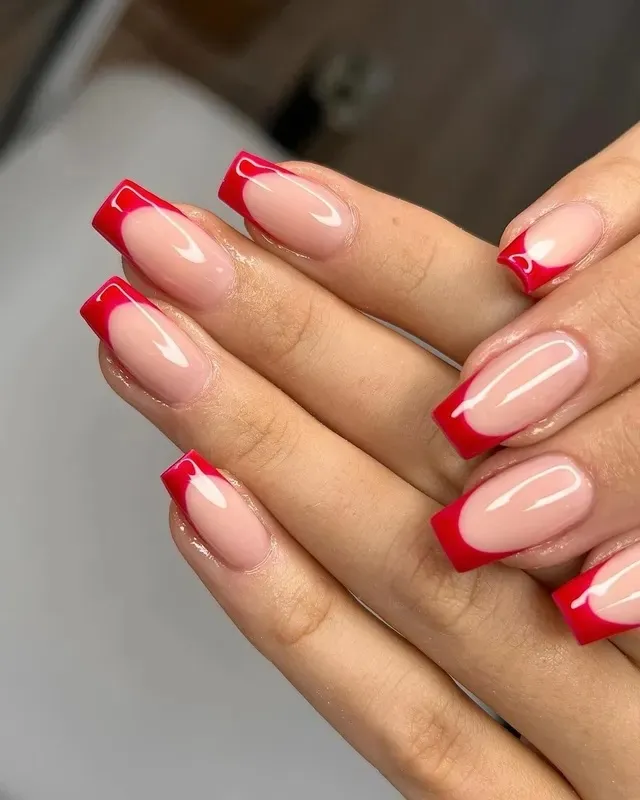
11. Red and White French
This pairs a red base or accent with the traditional white tip, or alternates red and white tips across the set. It reads as more playful than an all-red French manicure and works well for summer or Fourth of July styling.
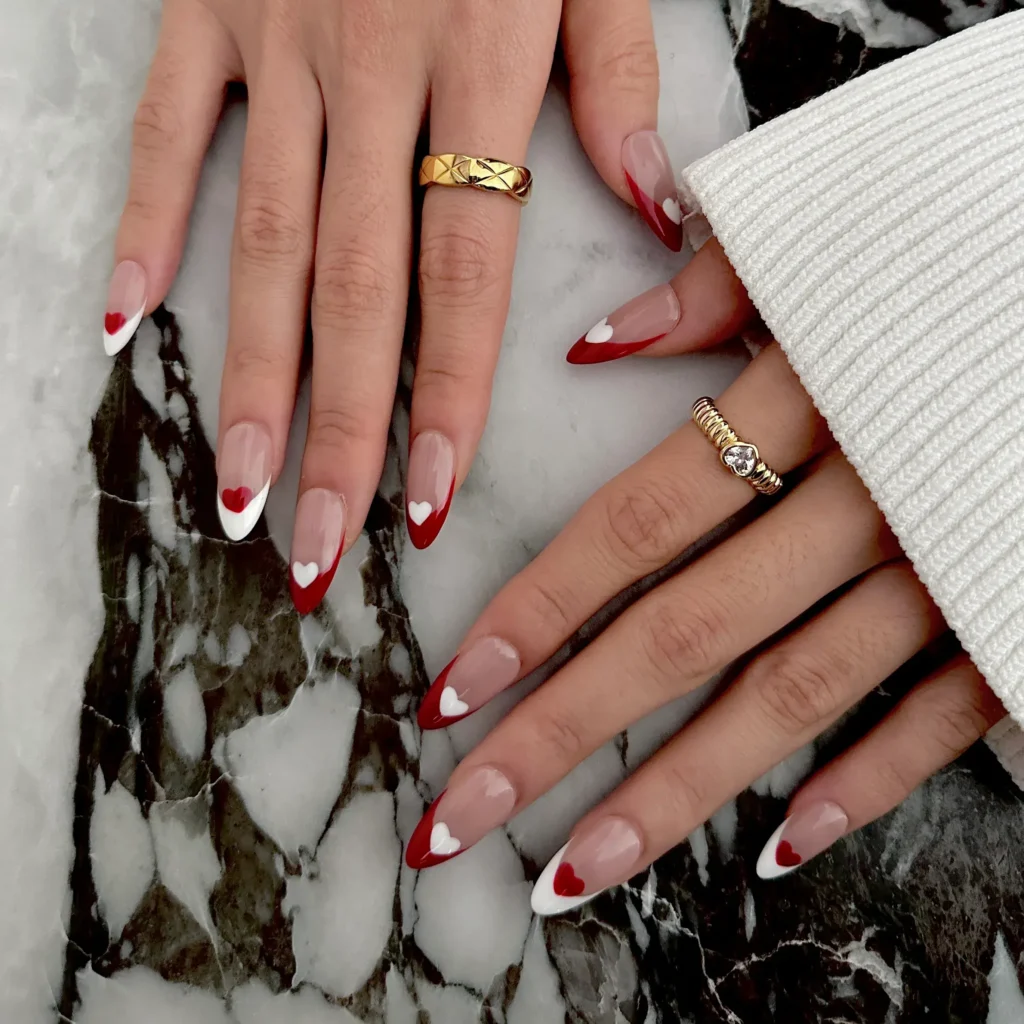
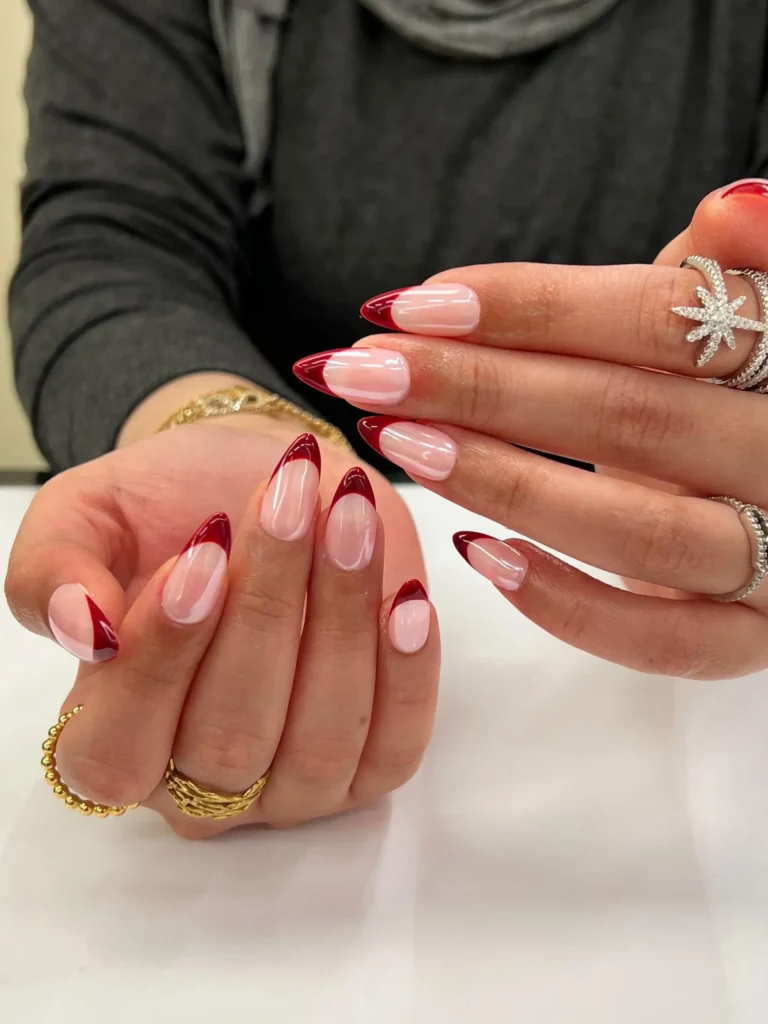
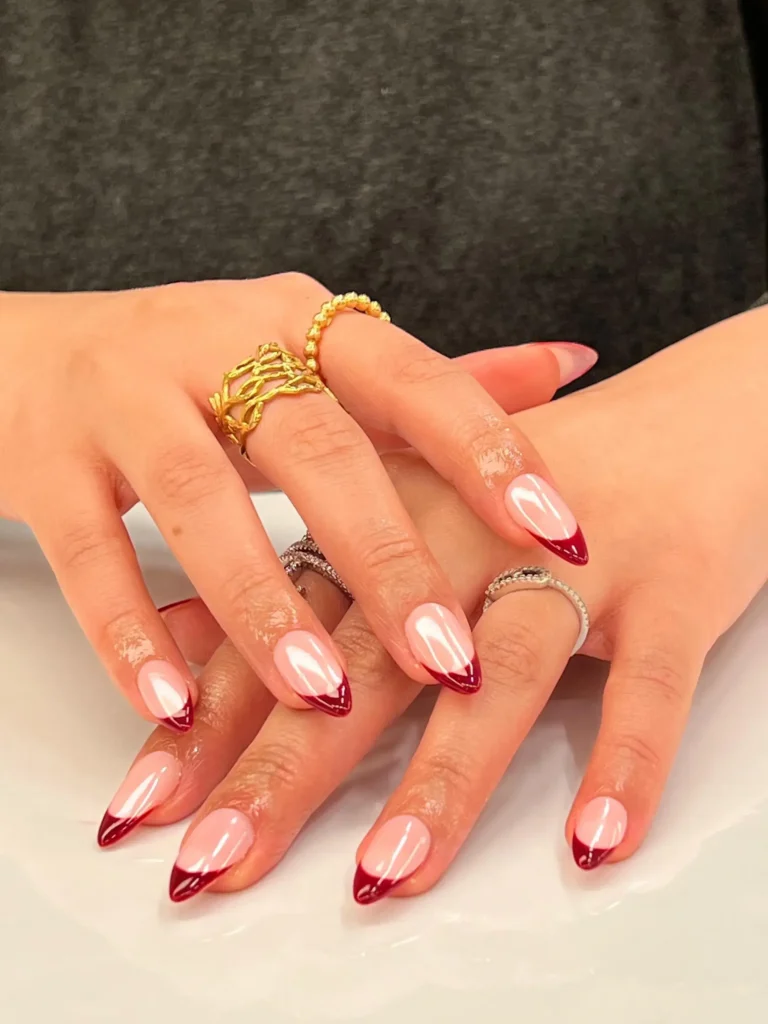
12. Monochrome Mani (Red-on-Red Tonal French)
Both the base and the tip are red, but in two different shades. A deep oxblood tip over a brighter cherry base is a common pairing. The contrast is subtle, so the French shape still shows even though the whole nail reads red.
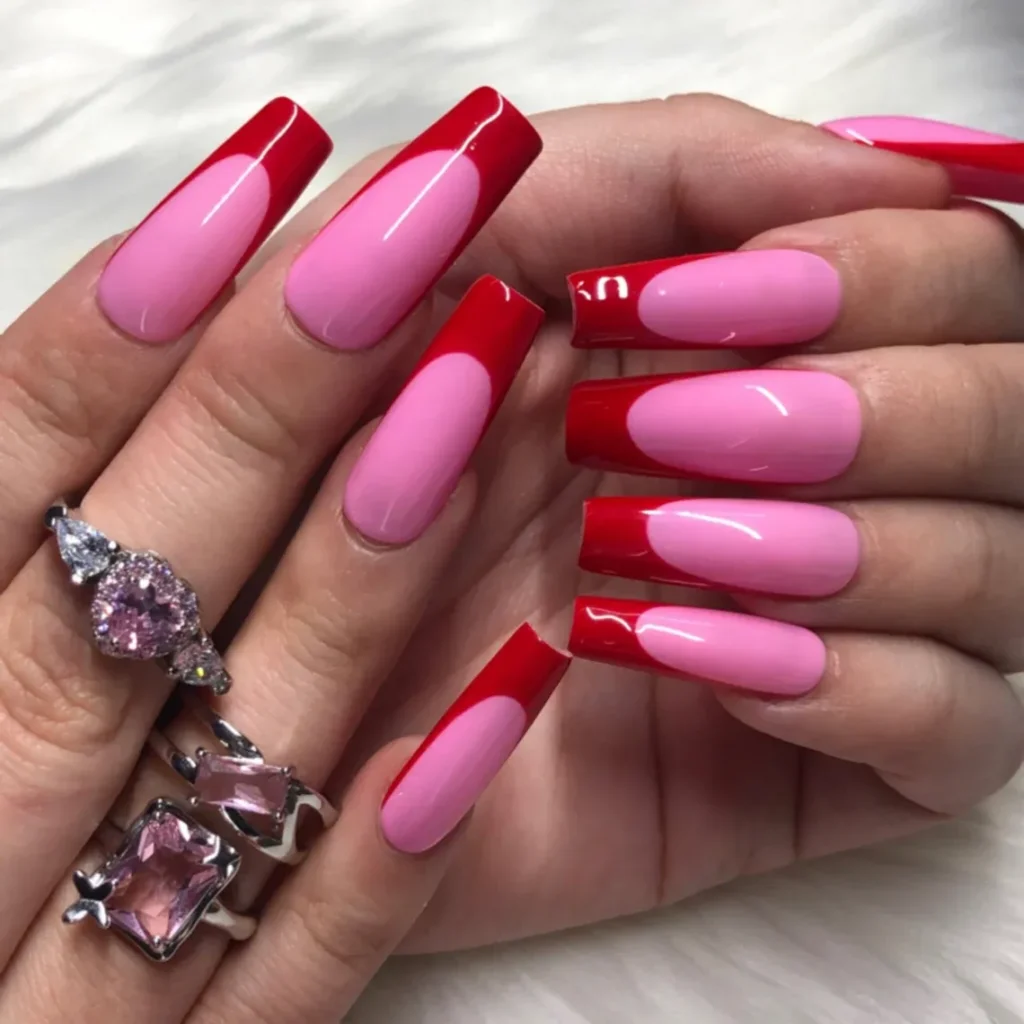
13. Pink and Red French
This swaps the usual nude or clear base for baby pink, then adds a red tip on top. The combination feels sweeter and more Valentine’s-coded than a standard red French tip. If pink on its own is more your speed, there’s a full range of rosy French manicure styles worth a look too.
Chrome & Metallic Red French Tips
These seven styles add reflective or metallic finishes to the red French tip, giving the design more shine and dimension than a standard glossy top coat.
14. Mirror Red Chrome
A red chrome powder or pigment is buffed over the tip to create a mirror-like, almost liquid-metal finish. Unlike a glossy red, this catches light from every angle instead of just reflecting a single shine point.
15. Red and Gold Chrome
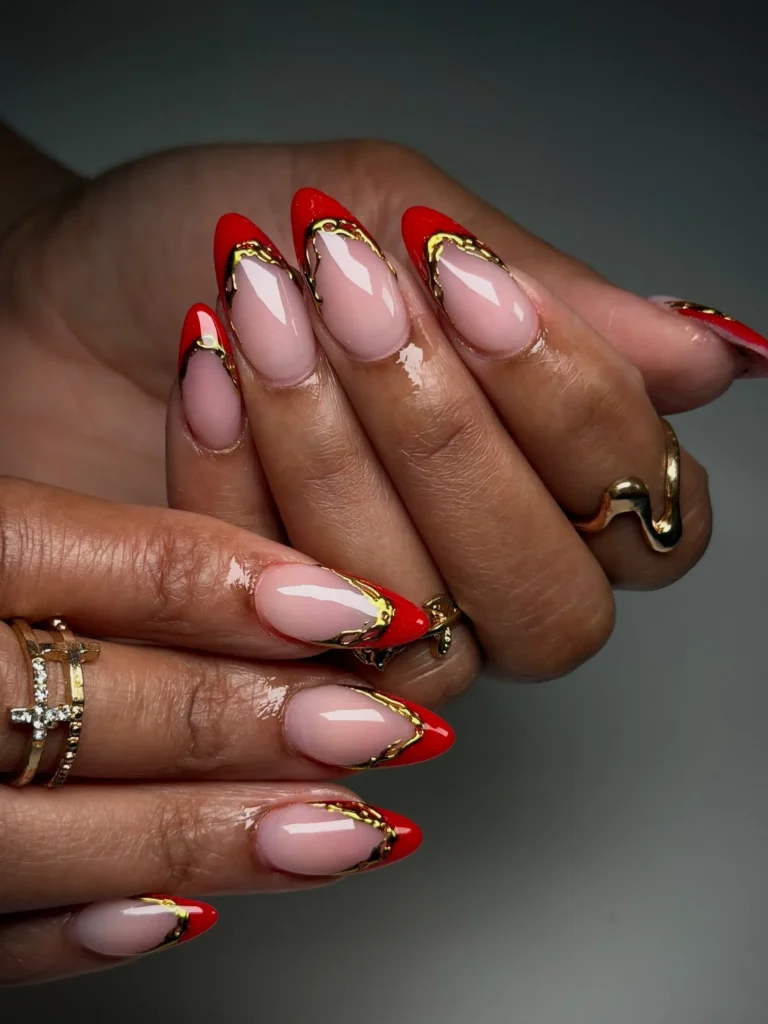
This pairs a red base or tip with gold chrome accents, either as a full metallic tip or as gold detailing along the smile line. The warm gold tone plays off the red without competing with it.
16. Chrome Outline
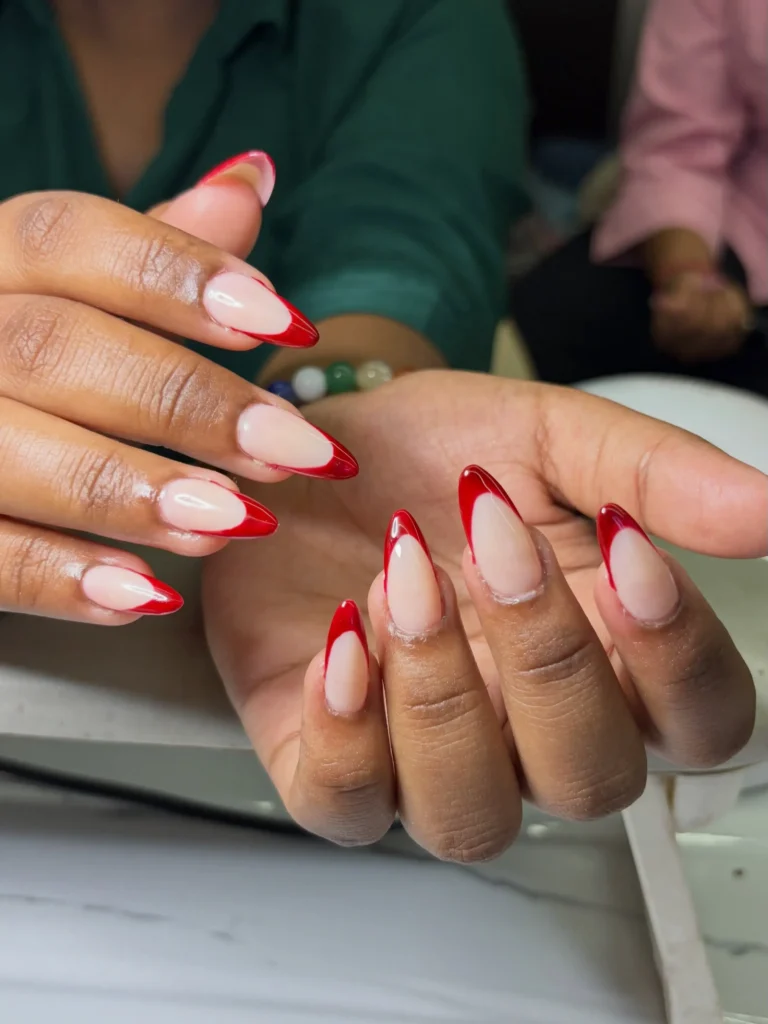
Instead of covering the whole tip, chrome pigment is applied only along the thin outline where the red tip meets the base. It creates a defined, glowing edge while keeping the rest of the nail matte or glossy.
17. Gold Starburst
Fine gold chrome is applied in a burst or swept pattern over part of the tip, rather than as a solid block of color. It gives the design a festive, celebratory feel without covering the red completely.
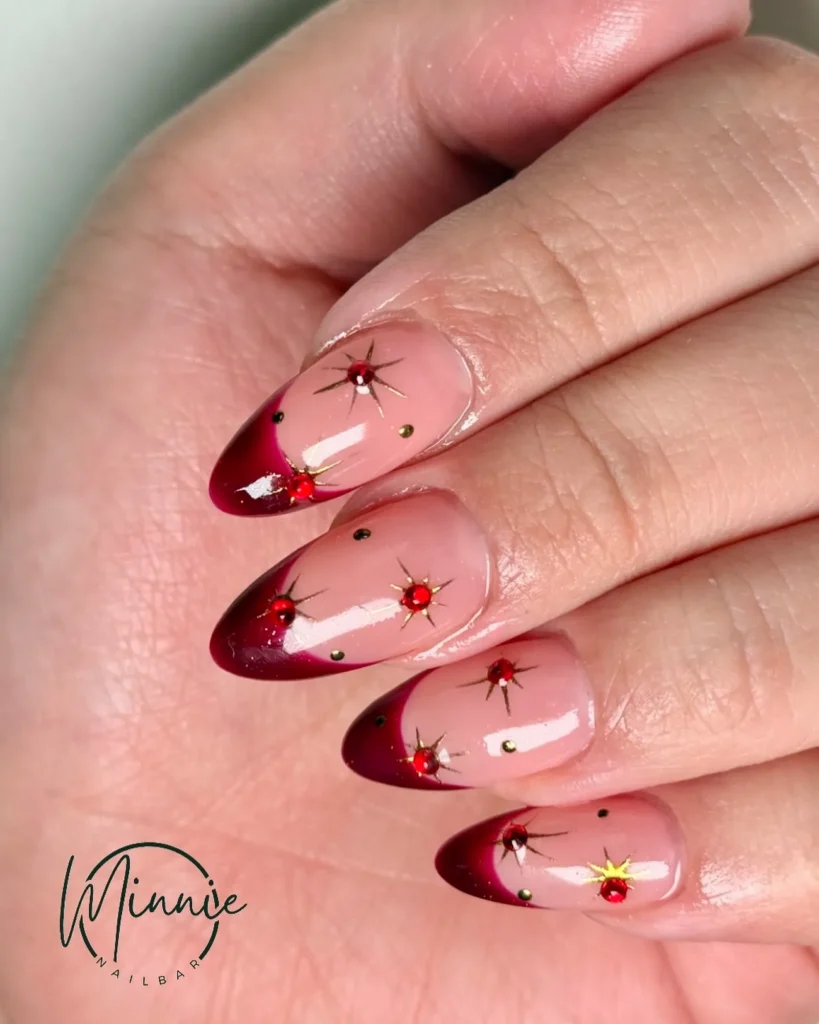
18. Glazed Red French
This borrows the “glazed donut” technique: a sheer, pearlescent chrome powder is dusted over the entire red tip, softening the color and giving it a hazy, glassy shine instead of a flat, saturated finish.
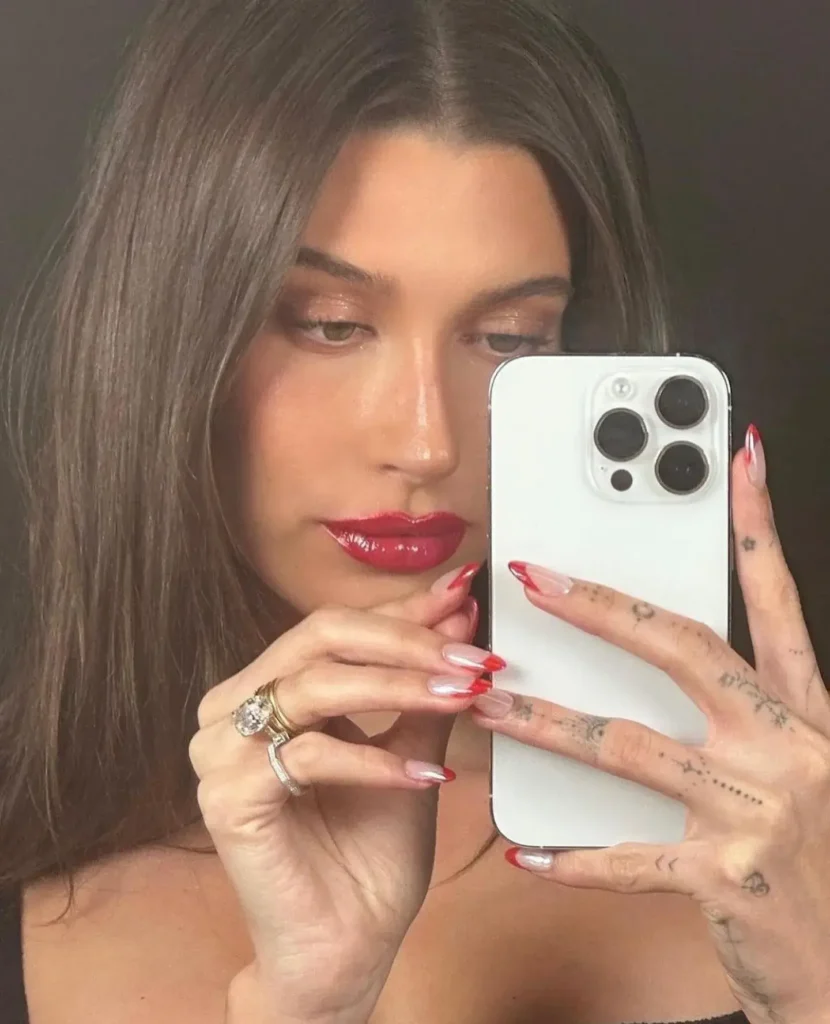
19. Silver Chrome French
The same mirror effect as red chrome, but in silver instead of gold. It reads as cooler and more modern, and pairs especially well with blue-based reds like cherry or oxblood.
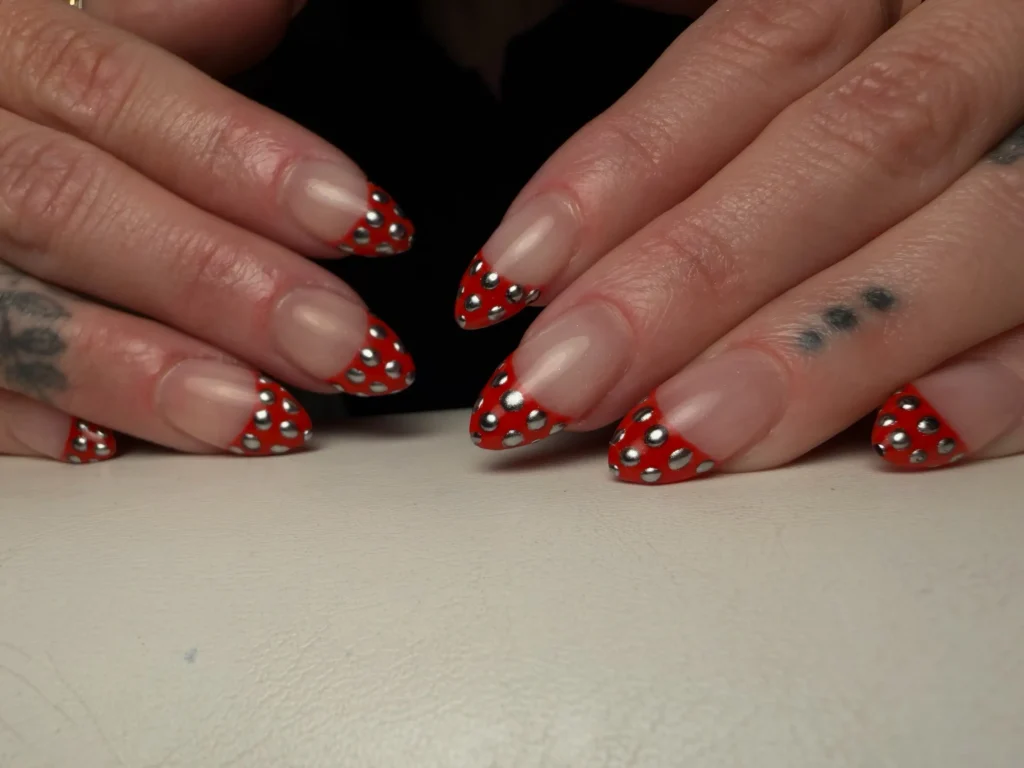
20. Minimal with a Midas Touch
This keeps most of the nail plain and unpolished, then adds one small metallic gold detail, like a thin wire, a dot, or a fine line, near the cuticle or smile line. It’s the most understated option in this category.
Cat-Eye & Velvet Red French Tip Nail Designs
These five styles use magnetic or textured finishes to give the red tip depth and movement, instead of a flat, single-tone color.
21. Red Cat-Eye French
A magnetic red gel is applied to the tip, then a magnet is held over the wet polish before curing. This pulls the reflective particles into a single line of light, creating a glowing, lens-like effect that shifts as your hand moves.
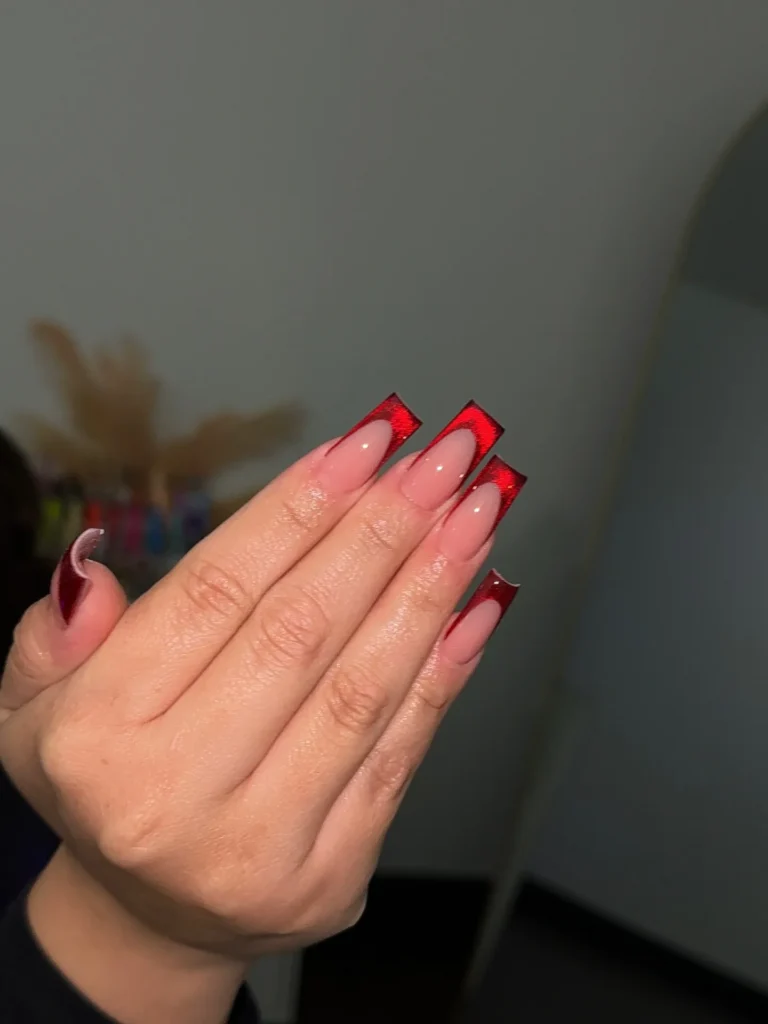
22. Red Velvet French
Fine flocking powder or a matte polymer is applied over the red tip, giving it a soft, light-absorbing texture that looks like fabric instead of polish. Paired with a glossy base, the contrast between the two finishes stands out.
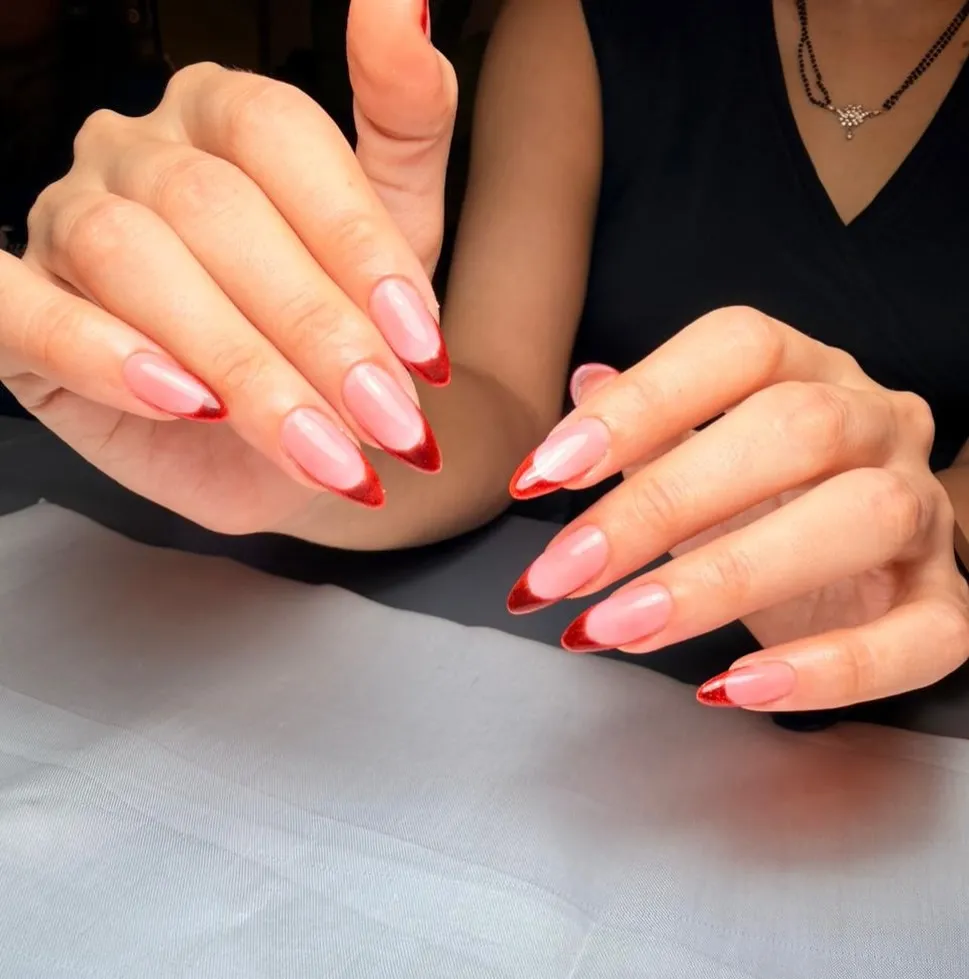
23. Cashmere Tips
This pairs a glossy, translucent base with a completely matte red tip. The name comes from the soft, suede-like texture of the matte finish, which reads as cozier and less flashy than a full glossy red.
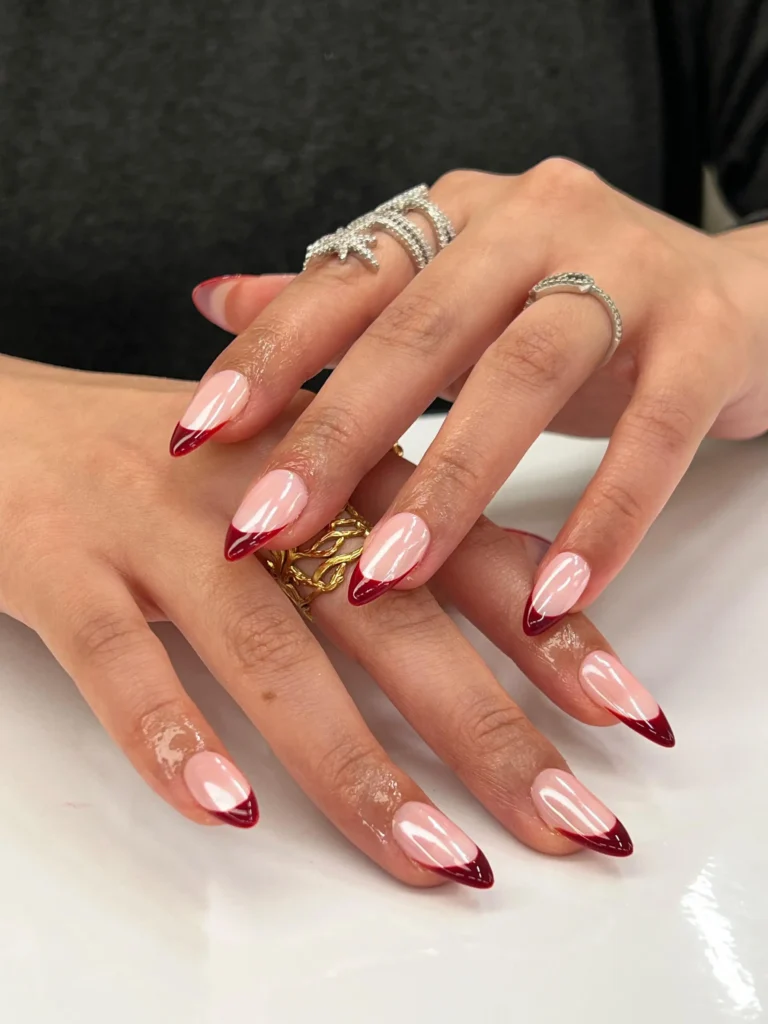
24. Velvet Twinkle
A velvet-textured red tip is finished with a scattering of fine glitter or micro-shimmer on top. It keeps the soft, matte base texture while adding small points of sparkle.
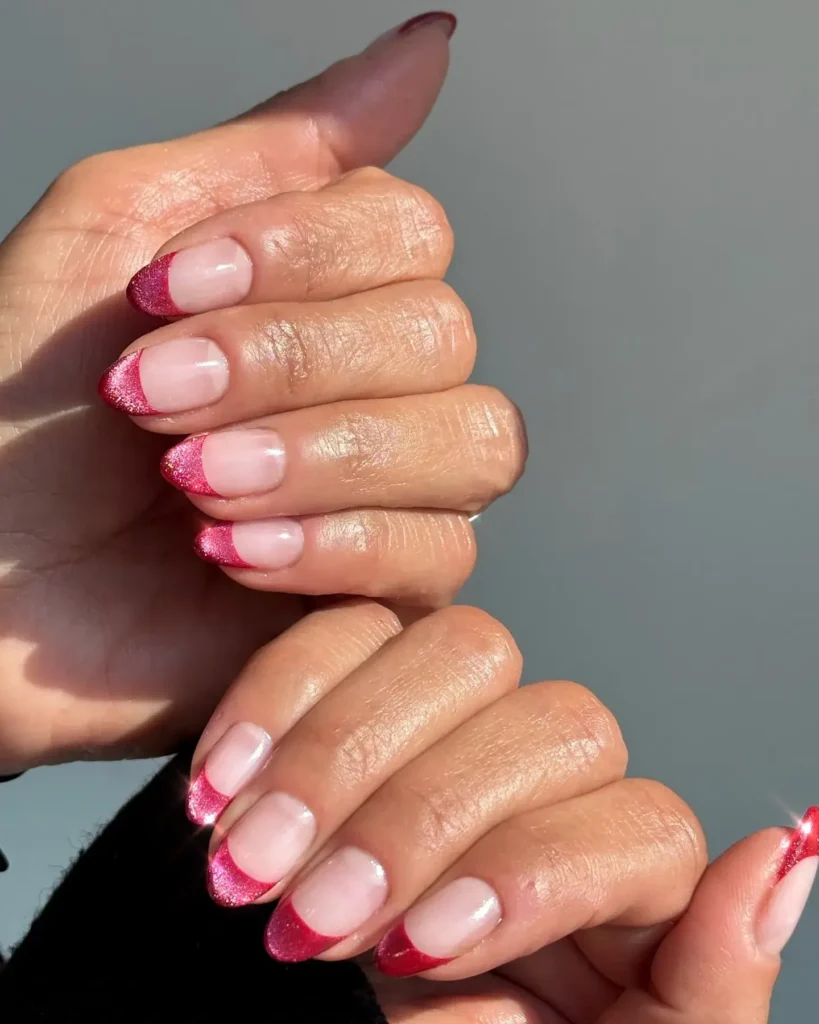
25. Cat-Eye Base
Instead of applying the cat-eye effect only to the tip, the magnetic gel covers the entire nail, base included. The tip is then defined with a thin outline or a slightly deeper shade, so the French shape still reads clearly under the shimmer.
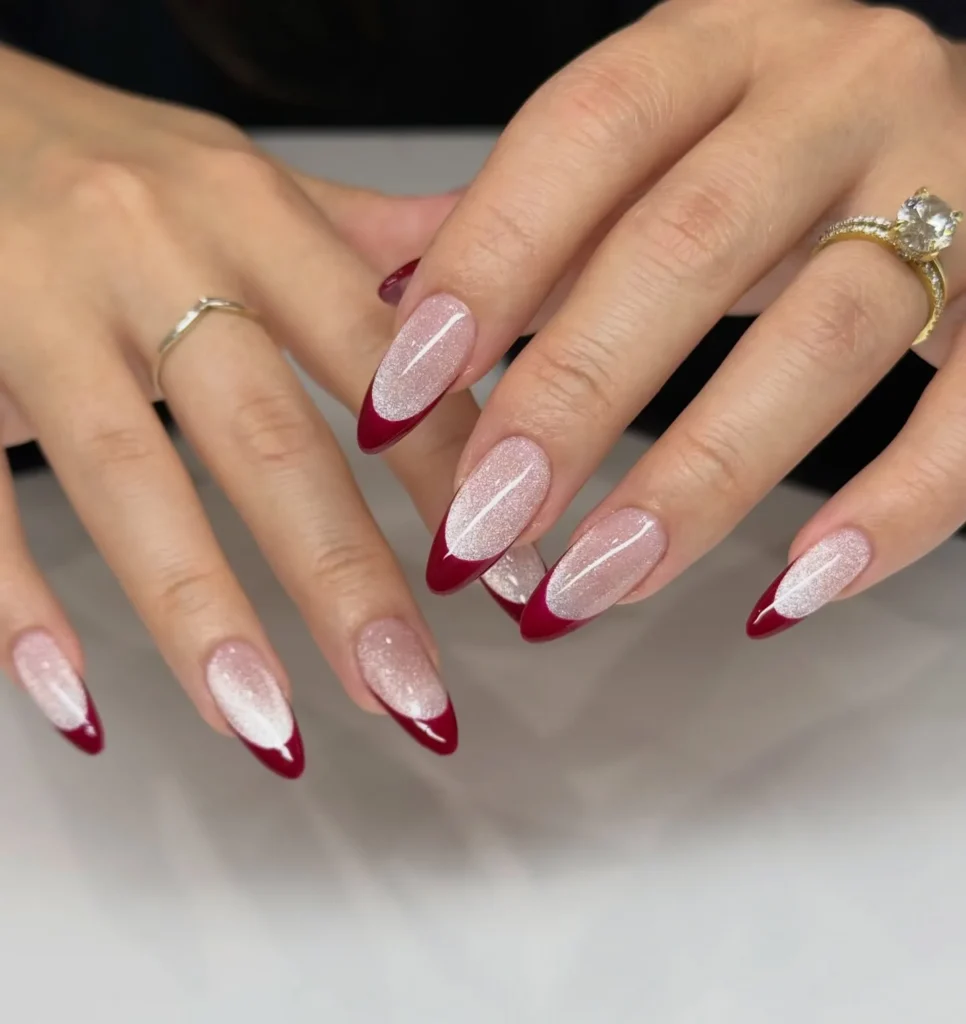
Glitter & Sparkle Red French Tips
These seven styles bring texture and shine through glitter or crystals, rather than chrome or a magnetic finish. They work well for holidays and events where a little extra sparkle fits the occasion.
26. Glitter Red French
Red glitter polish replaces solid red as the tip color. Depending on the glitter size, this can look like fine shimmer or chunky sparkle, and it holds light in a way flat polish can’t.
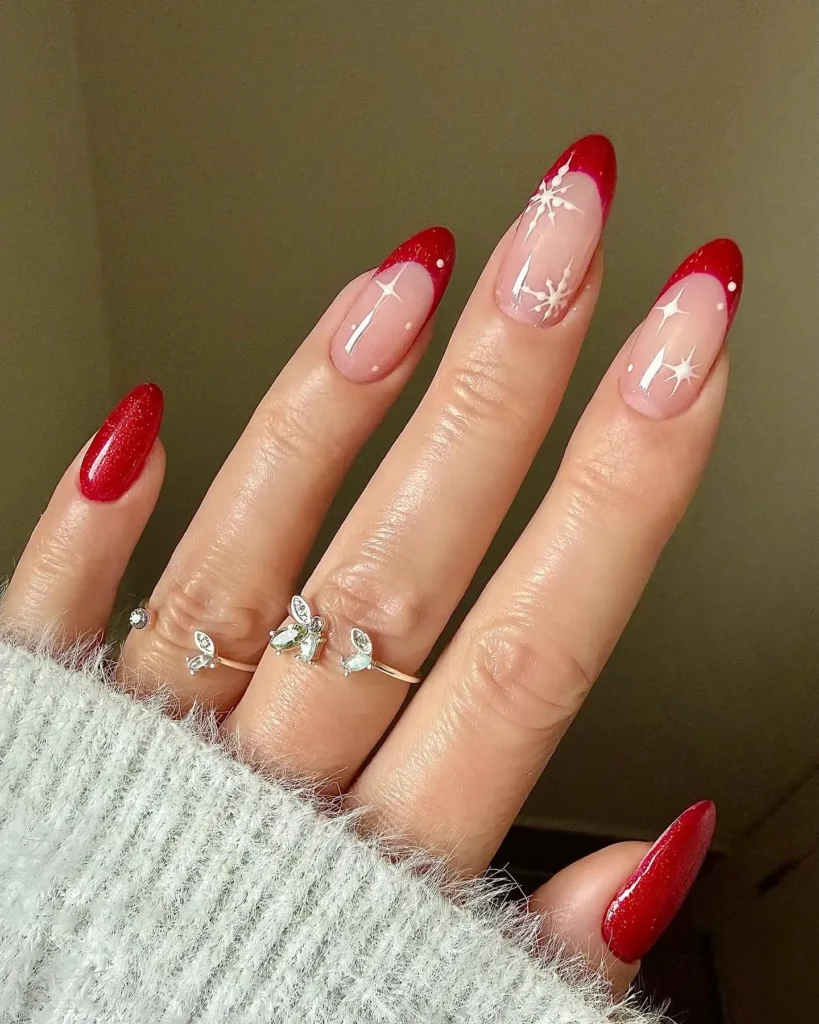
27. Glitter Ombré
Glitter is applied heaviest at the tip, then fades out toward the cuticle instead of stopping at a hard line. This blurs the usual French tip boundary and gives the design a softer, more blended look.
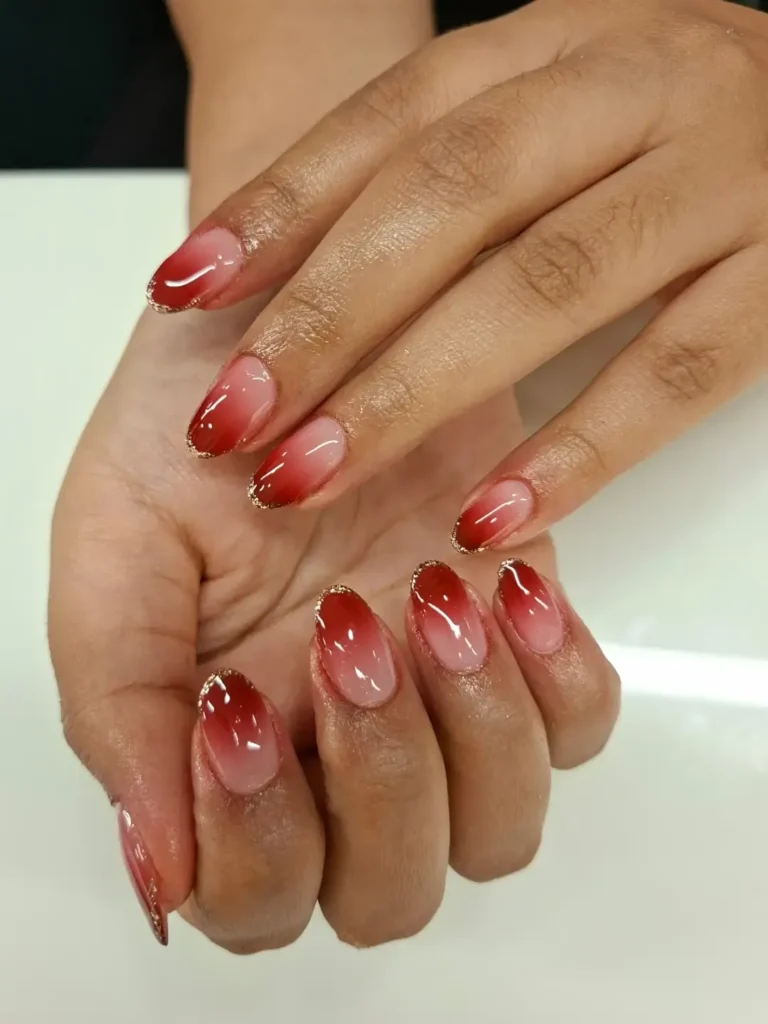
28. Sparkle Drip
Glitter or fine metallic flecks are painted in loose, drip-like streaks down from the tip, instead of filling the tip evenly. It reads as more artistic and less symmetrical than a standard glitter tip.
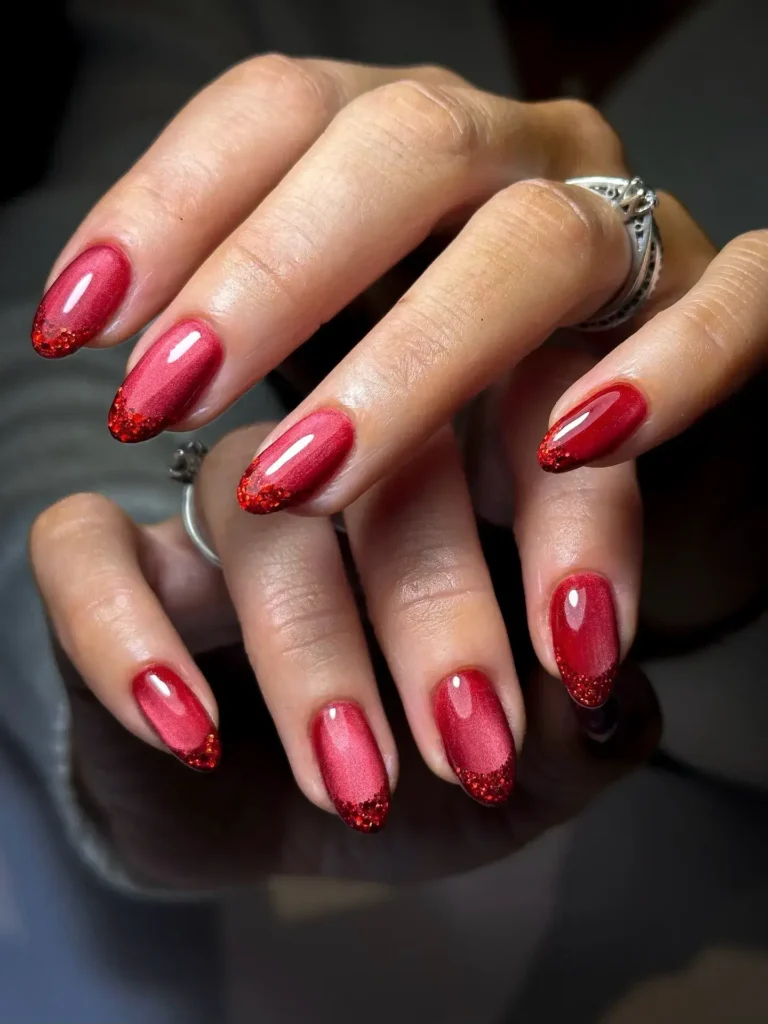
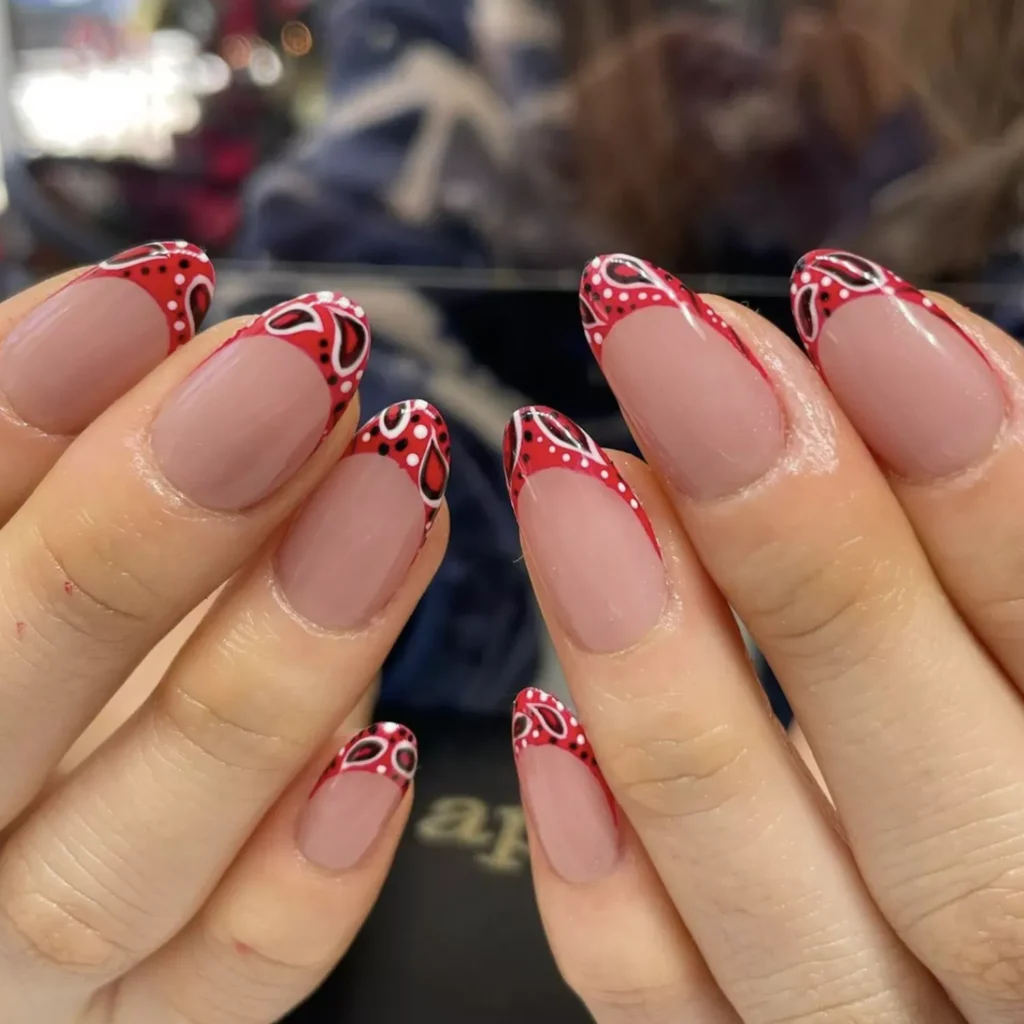
29. Glitter and Plaid
One or two accent nails feature a hand-painted plaid pattern in red, black, or white, while the rest of the set stays a plain red French tip with a glitter nail mixed in. It’s a common winter and holiday pairing.
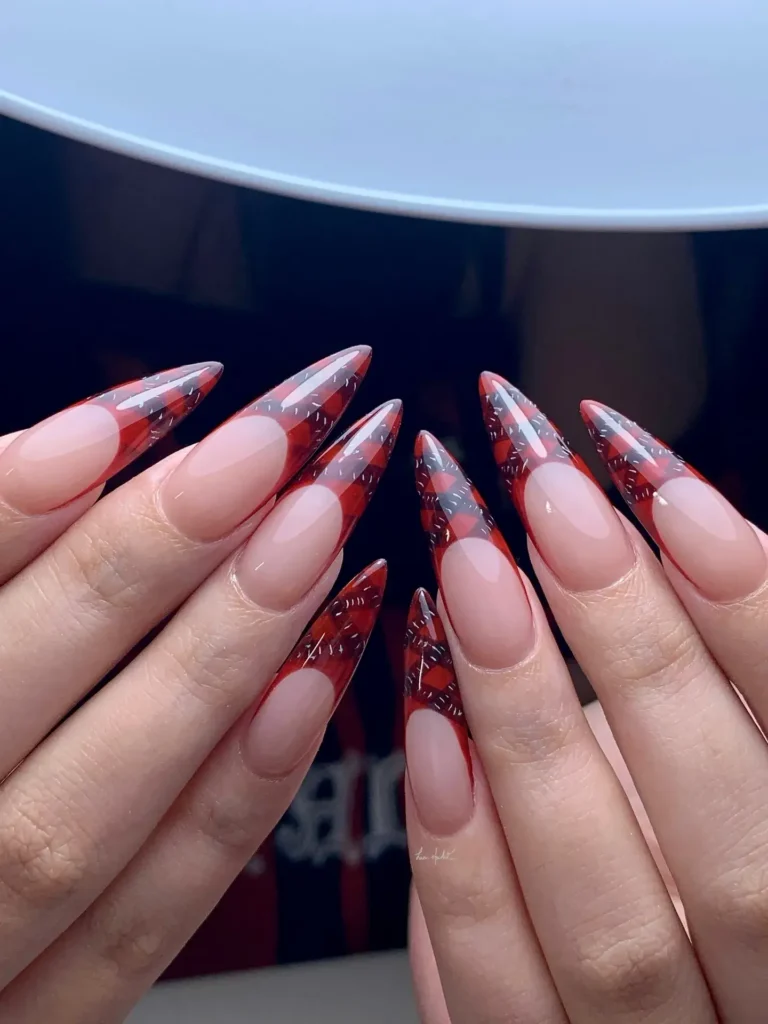
30. Glitter Base
The glitter goes on the base of the nail instead of the tip, which stays a plain red. This flips the usual placement and puts the sparkle where your eye lands first.
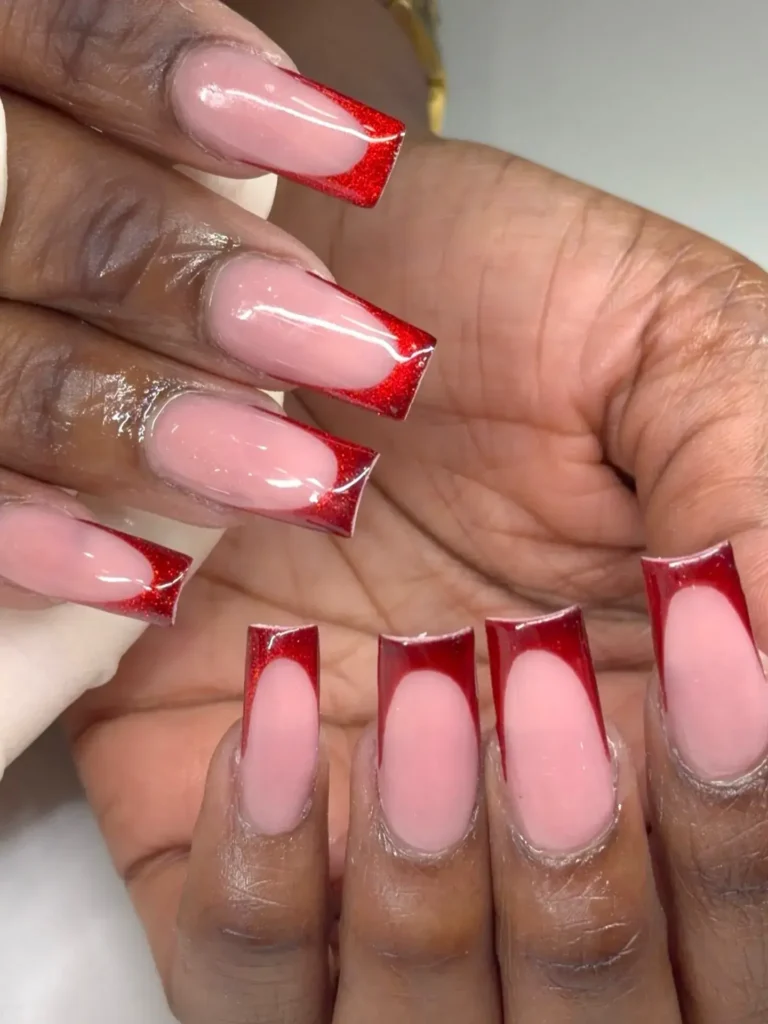
31. Glitter-Edged Tips
A thin line of fine glitter runs along the exact edge where the red tip meets the base, similar to a chrome outline but with texture instead of shine. The rest of the tip stays a flat, matte or glossy red.
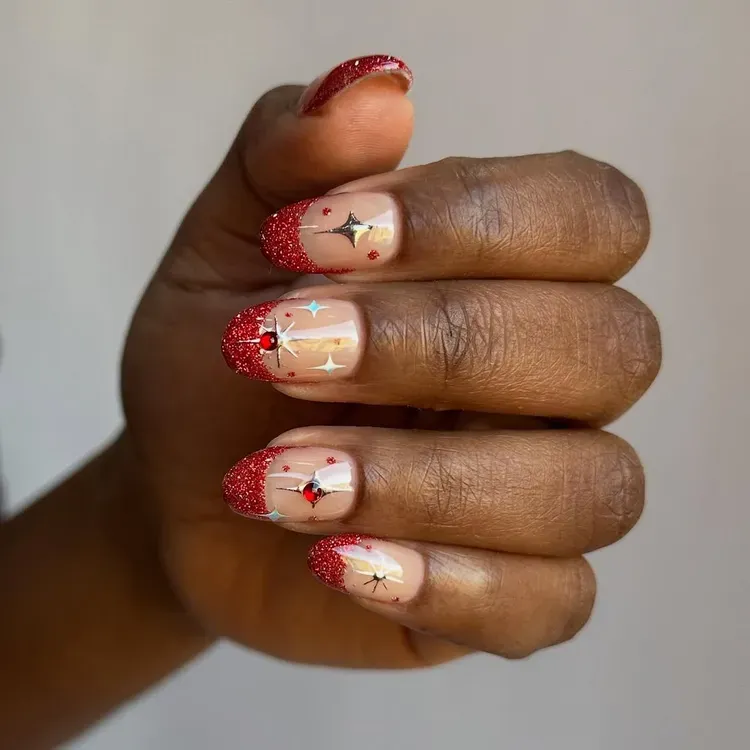
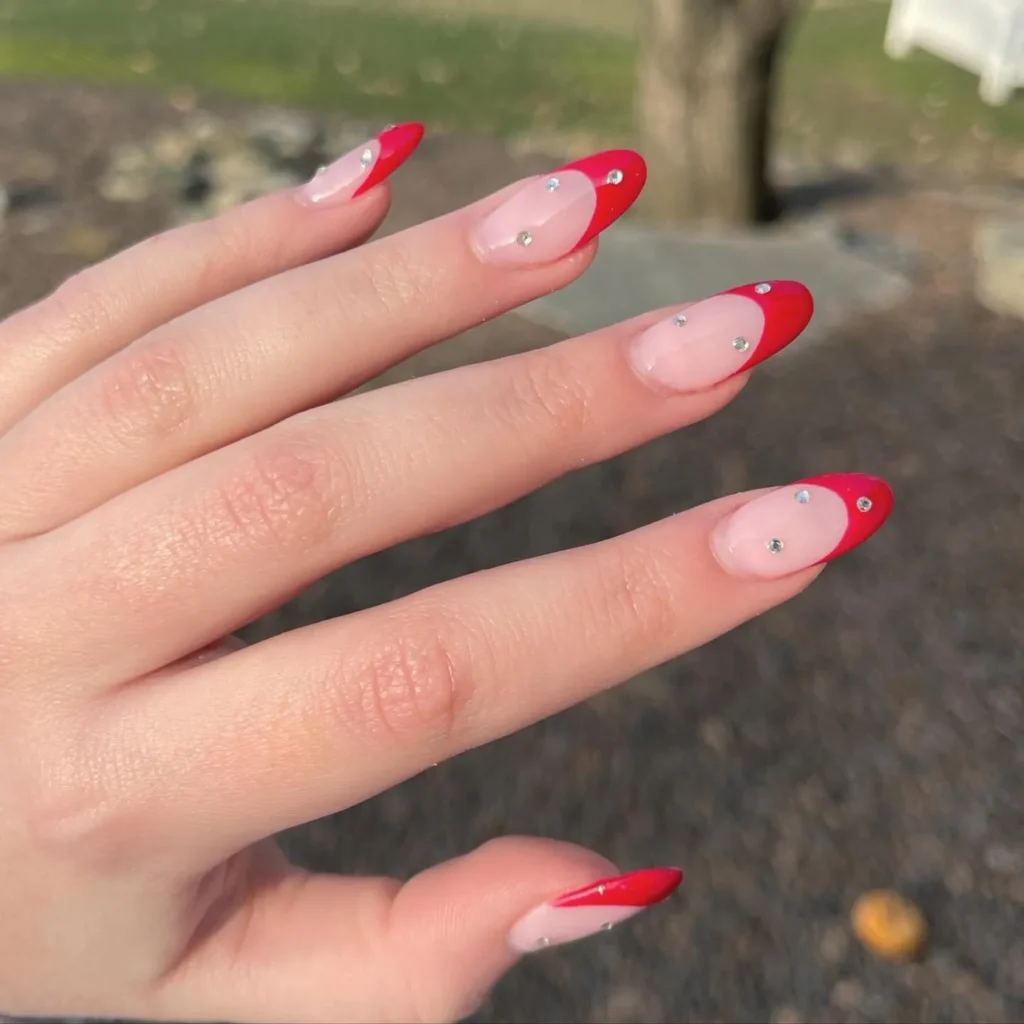
32. Rhinestone French Tips
Small flat-back crystals are placed along the smile line or scattered across the tip. Even a few crystals change the finish from a simple manicure to something dressier, without covering the nail in nail art.
Hand-Painted & Nail Art Accents
Nine designs bring fine detail work to the red French tip, using small hand-painted or airbrushed motifs instead of finish or texture changes.
33. Heart Accents
A small heart, usually painted in white or a contrasting shade, sits on one or two accent nails within an otherwise plain red French set. It’s a simple way to add a romantic touch without redesigning every nail.
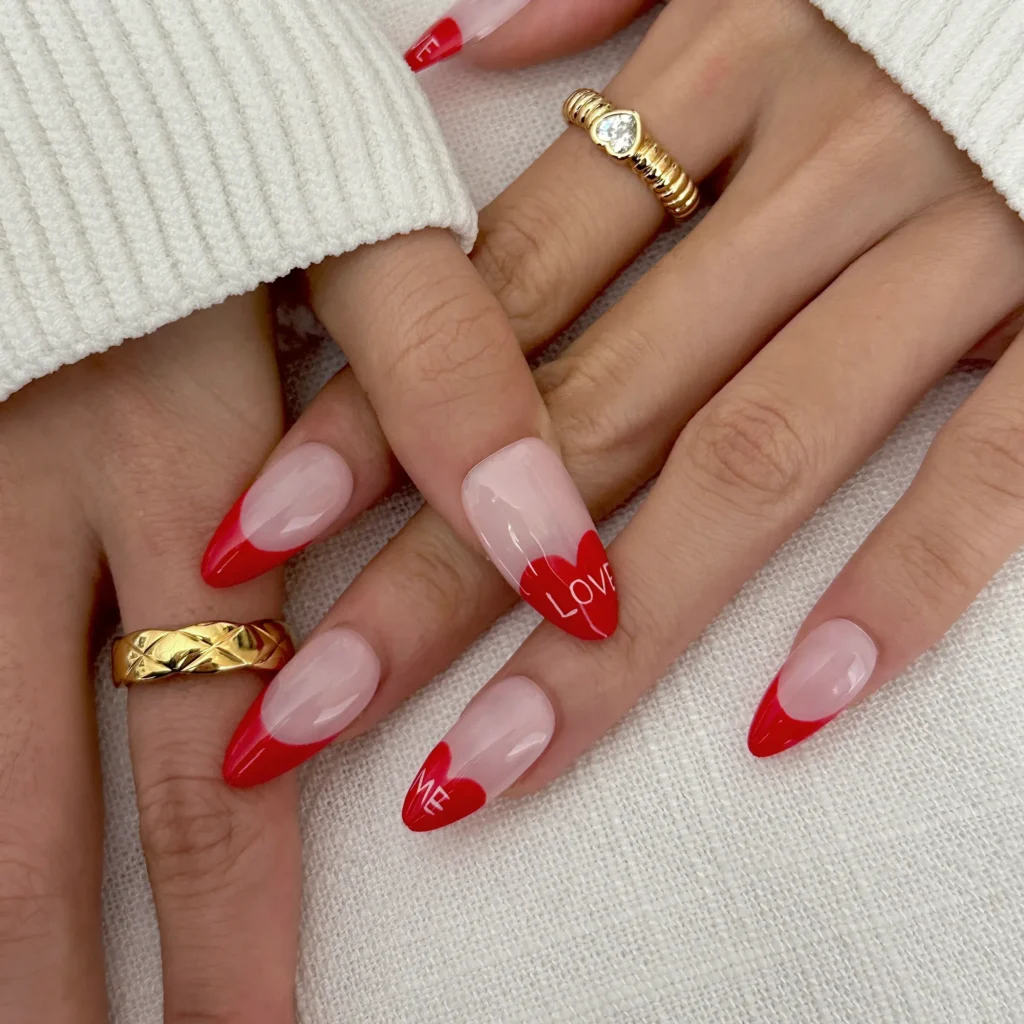
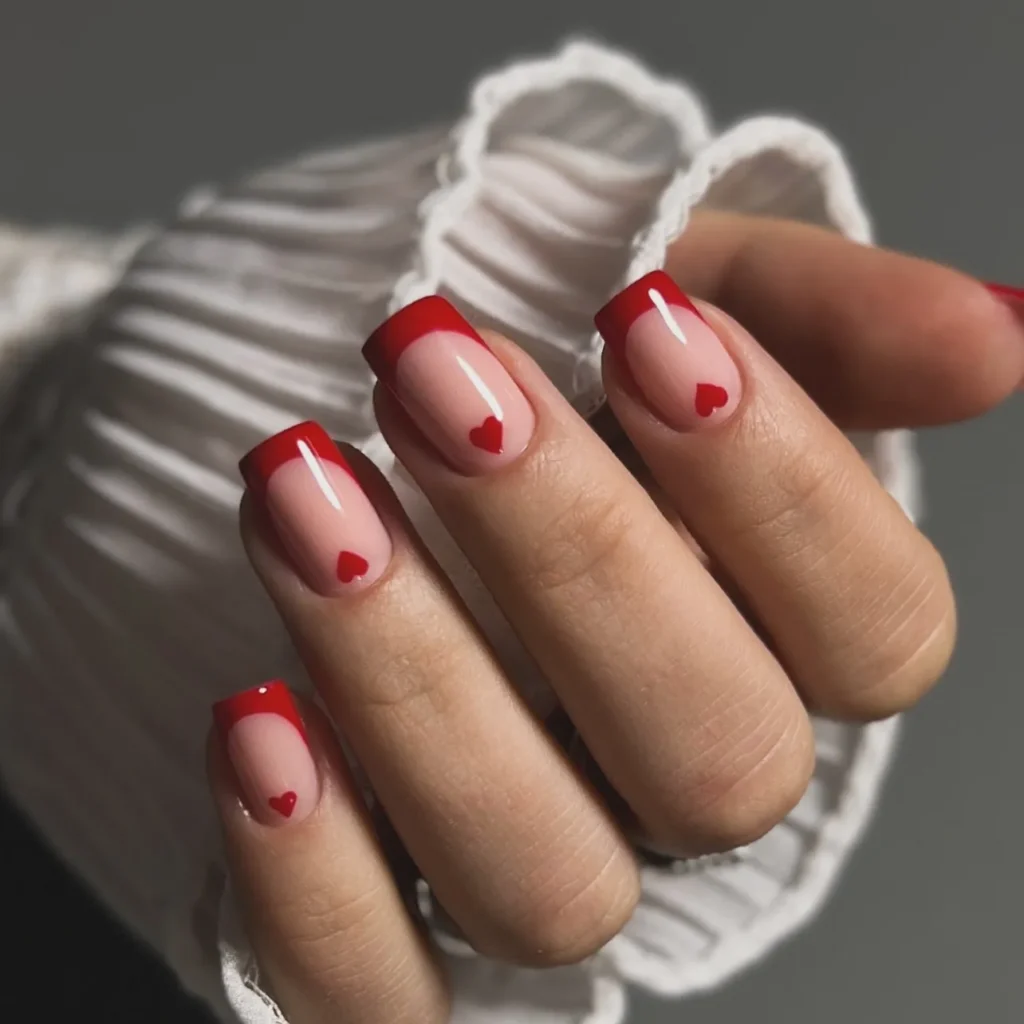
34. Tiny Hearts
Several miniature hearts are scattered near the smile line or cuticle across multiple nails, rather than one larger heart on a single accent nail. The smaller scale keeps the look subtle even with more detail added.
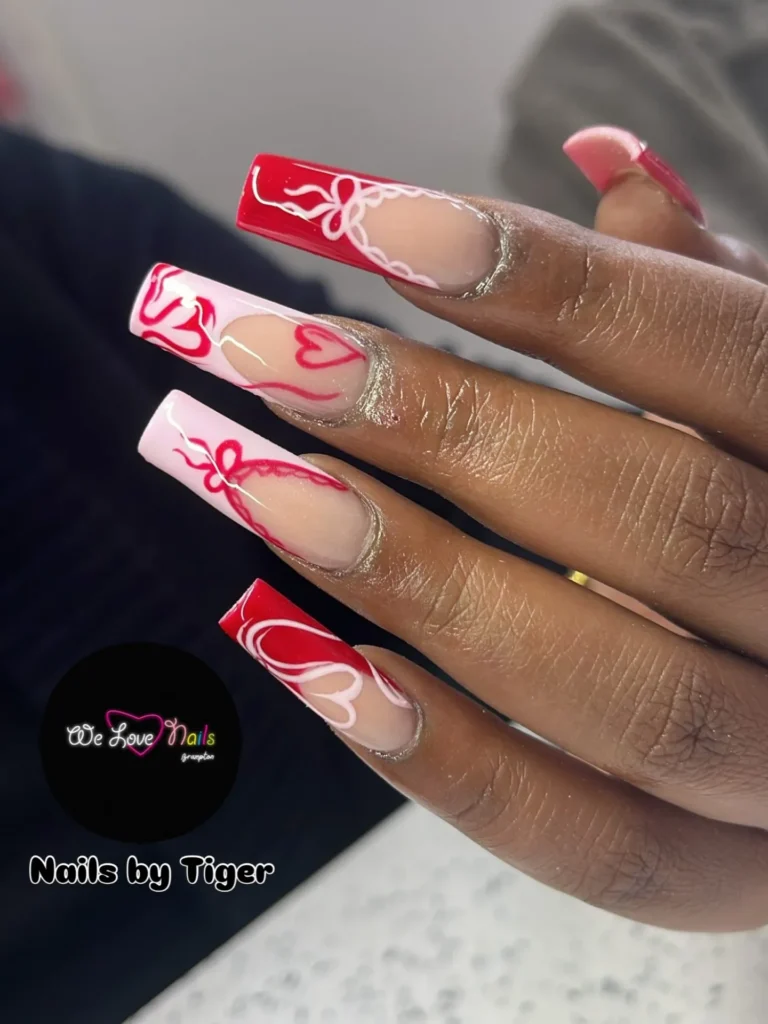
35. Airbrush Hearts
An airbrush gun sprays a soft-edged heart shape onto the nail, creating a faded, gradient look instead of a crisp painted outline. The blurred edges give this version a dreamier finish than hand-painted hearts.
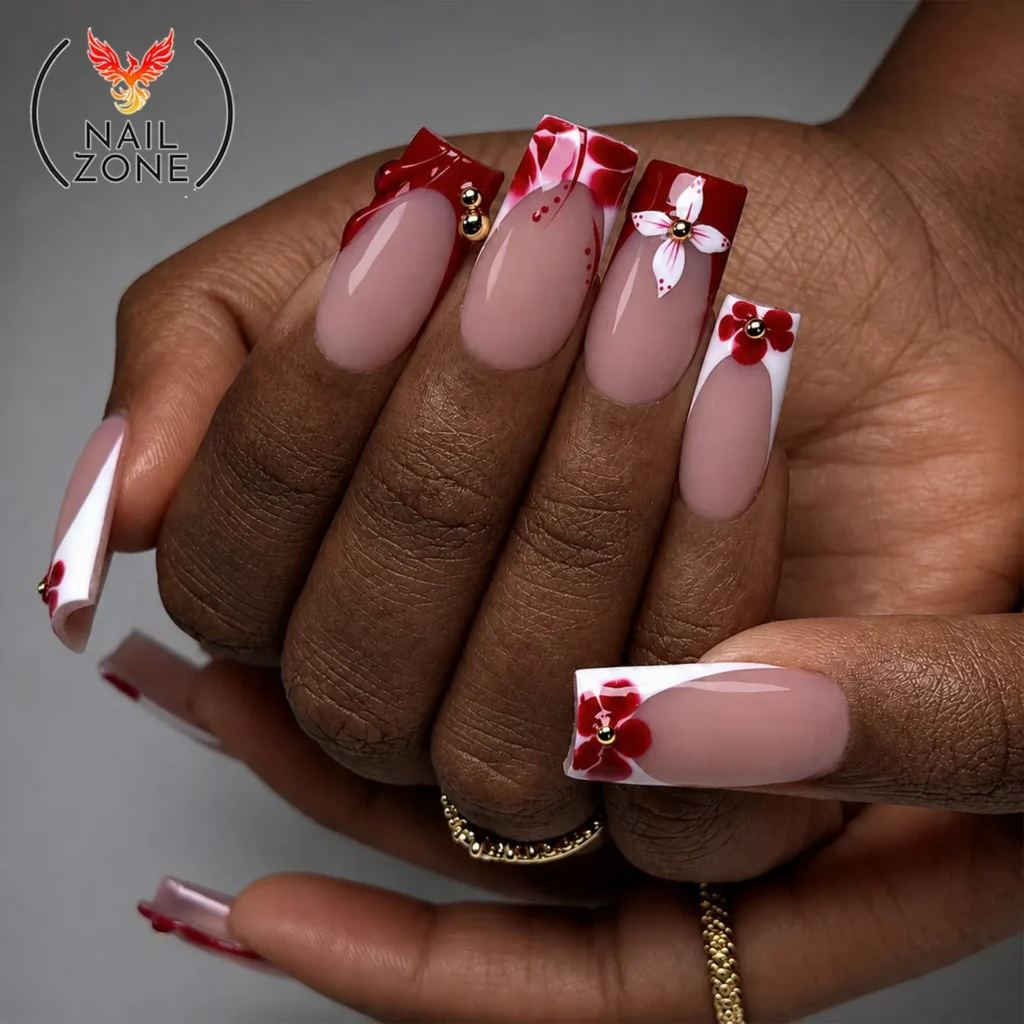
36. Red Floral French
Small flowers, painted in red or white, appear along the base or tip of the nail. Unlike an all-over floral manicure, the design stays limited to a few blooms so the French shape remains visible.
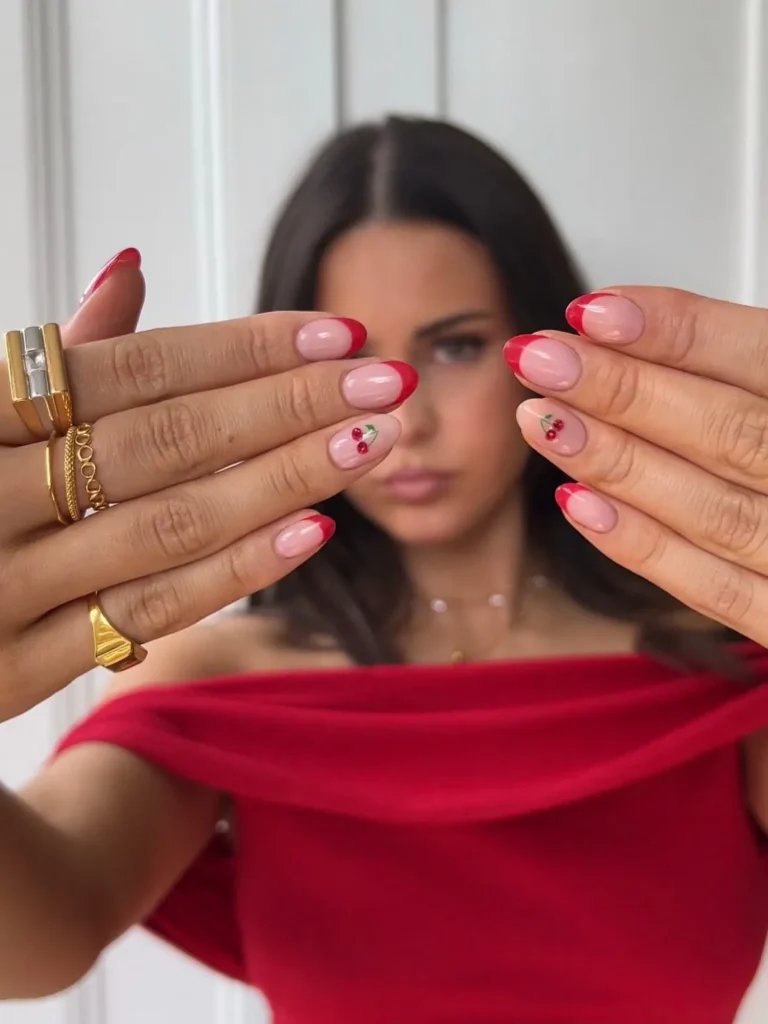
37. Cherry Accents
Tiny cherries, usually two joined by a stem, are painted near the cuticle or on a single accent nail. The motif nods to the “cherry” naming often used for red nail shades and pairs naturally with a French tip base.
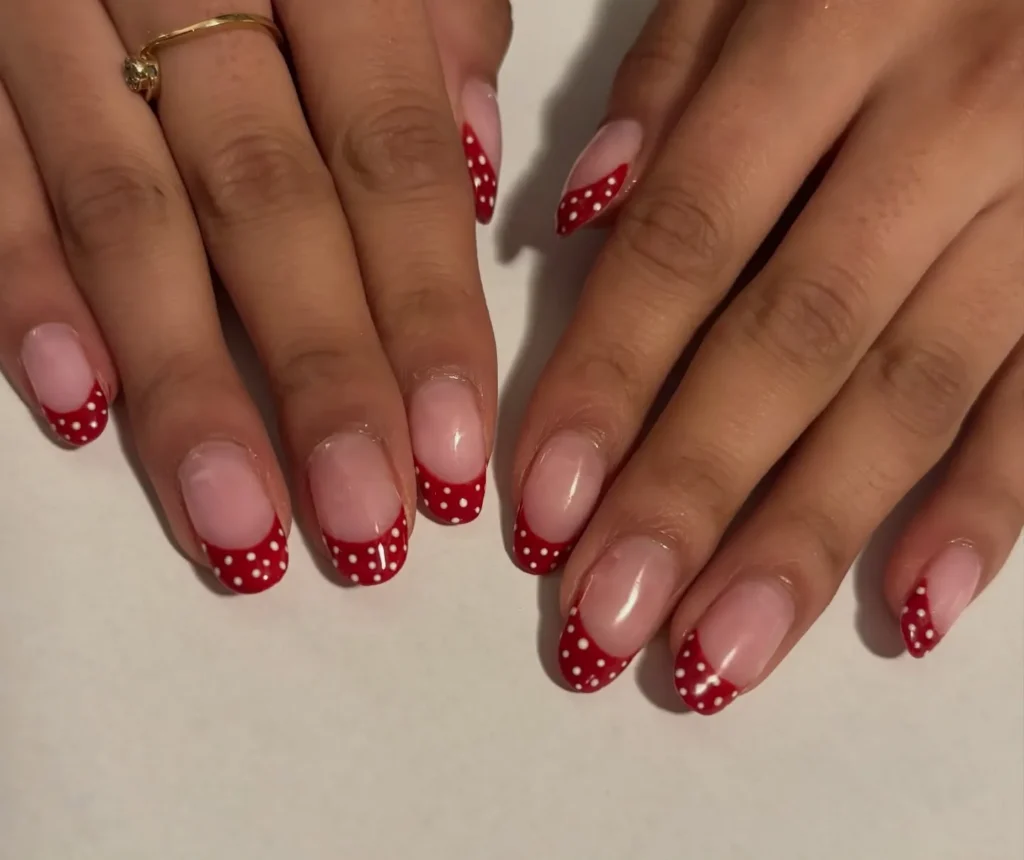
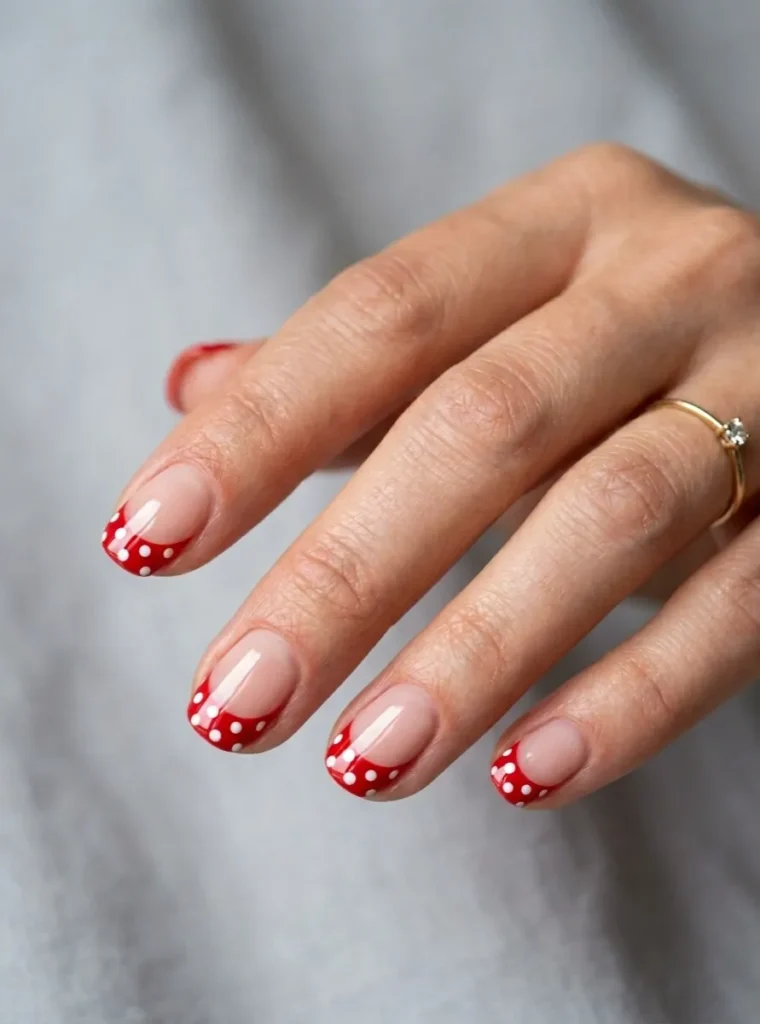
38. Polka Dot Red French
Small dots, either white on a red tip or red on a white or nude base, cover part or all of the nail. The pattern gives a retro feel and works on both classic and reverse French layouts.
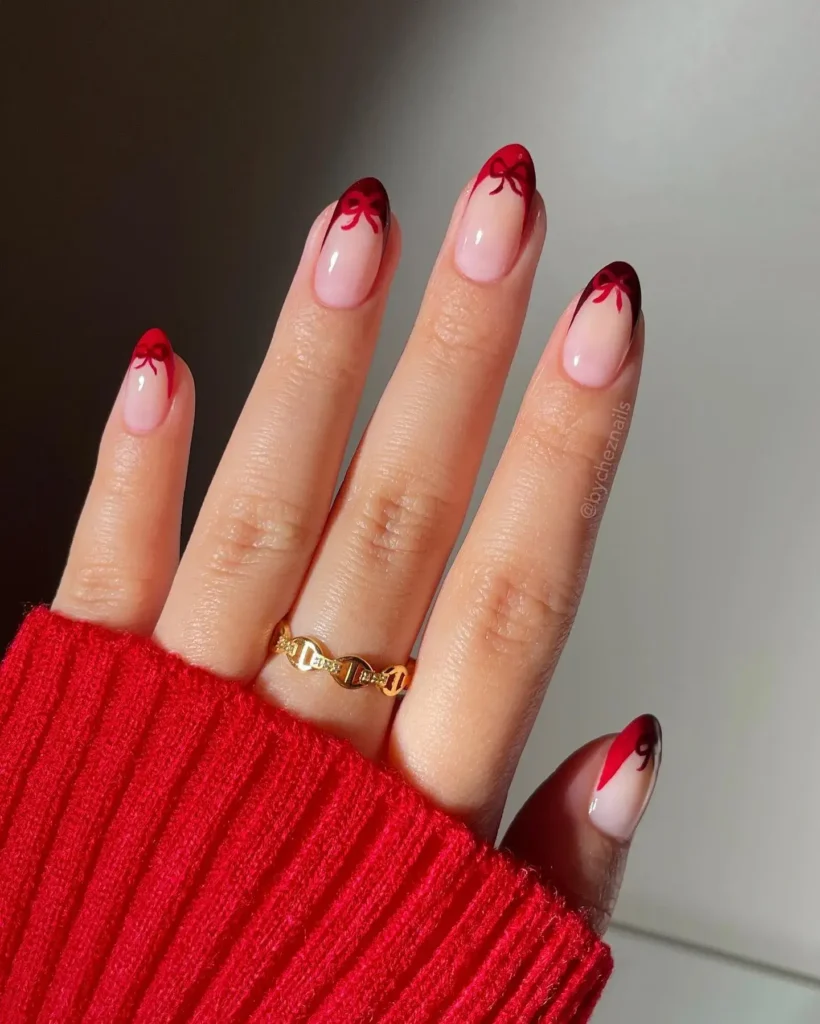
39. Bow Accents
A painted bow sits at the base of the nail or as a standalone accent on one finger. Bows read as more delicate than hearts and are common in coquette-style nail sets.
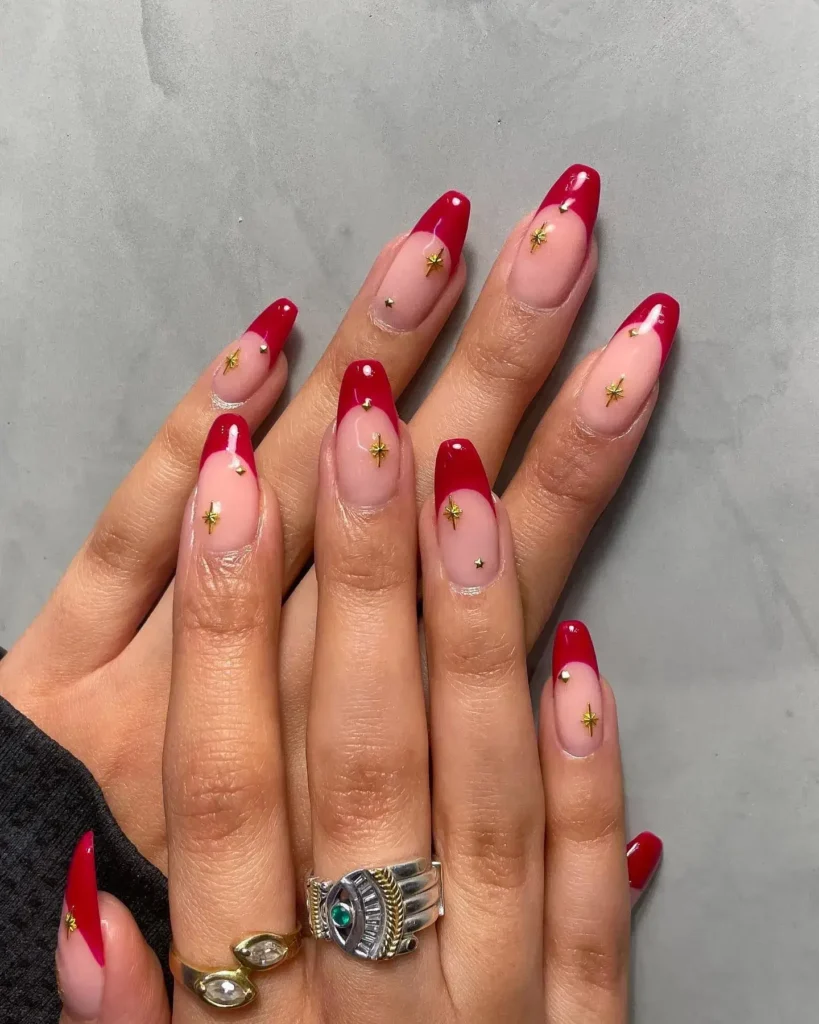
40. Starry French
Fine star shapes, often in white, gold, or silver, are scattered across the tip or base. Some versions cluster the stars near the cuticle, while others spread them across the whole nail for a night-sky effect.
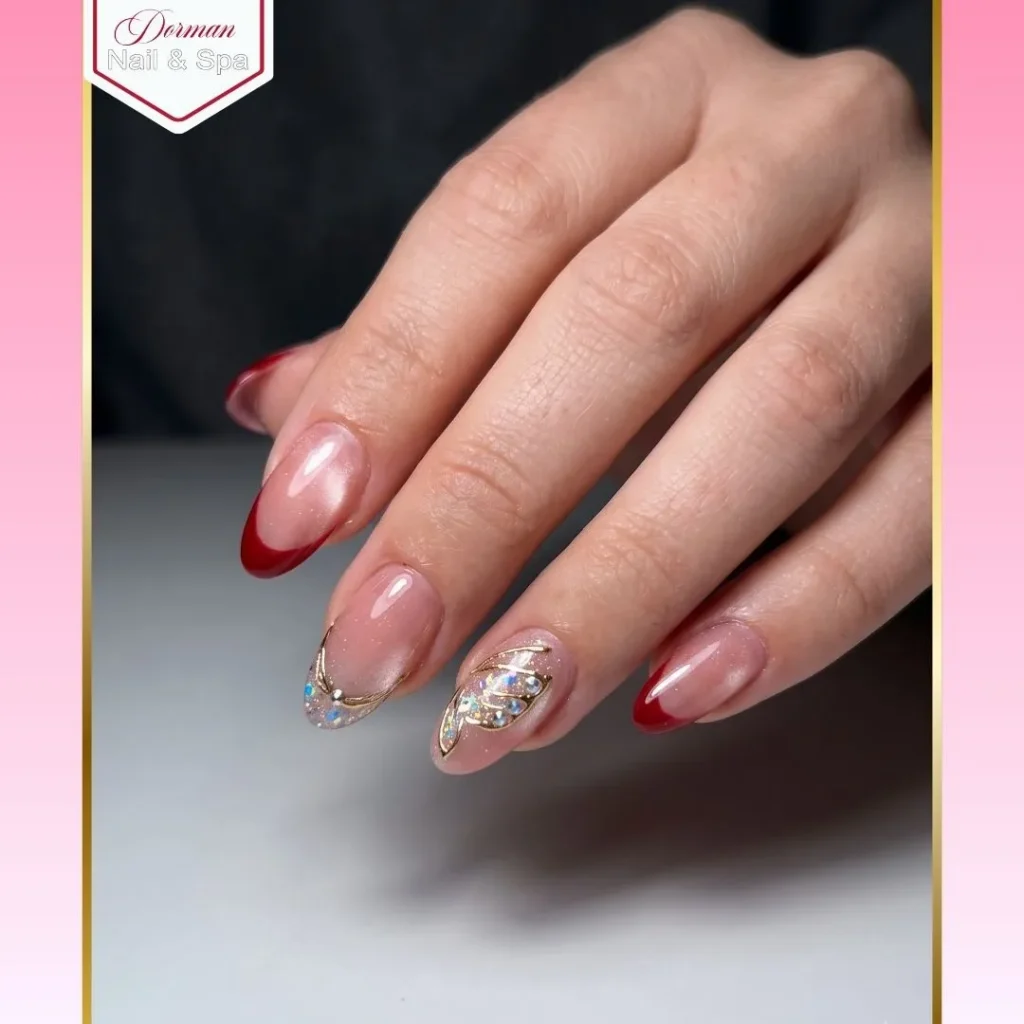
41. Butterfly Accent
A butterfly, usually painted or applied as a small decal, sits on one accent nail while the rest of the set stays a plain red French tip. The wings can pick up red, white, or metallic tones to tie into the rest of the design.
Geometric & Abstract Red French Tips
These eight designs replace the smile line’s soft curve with sharp angles, broken lines, or freeform shapes. They give the French tip format a more graphic, modern edge.
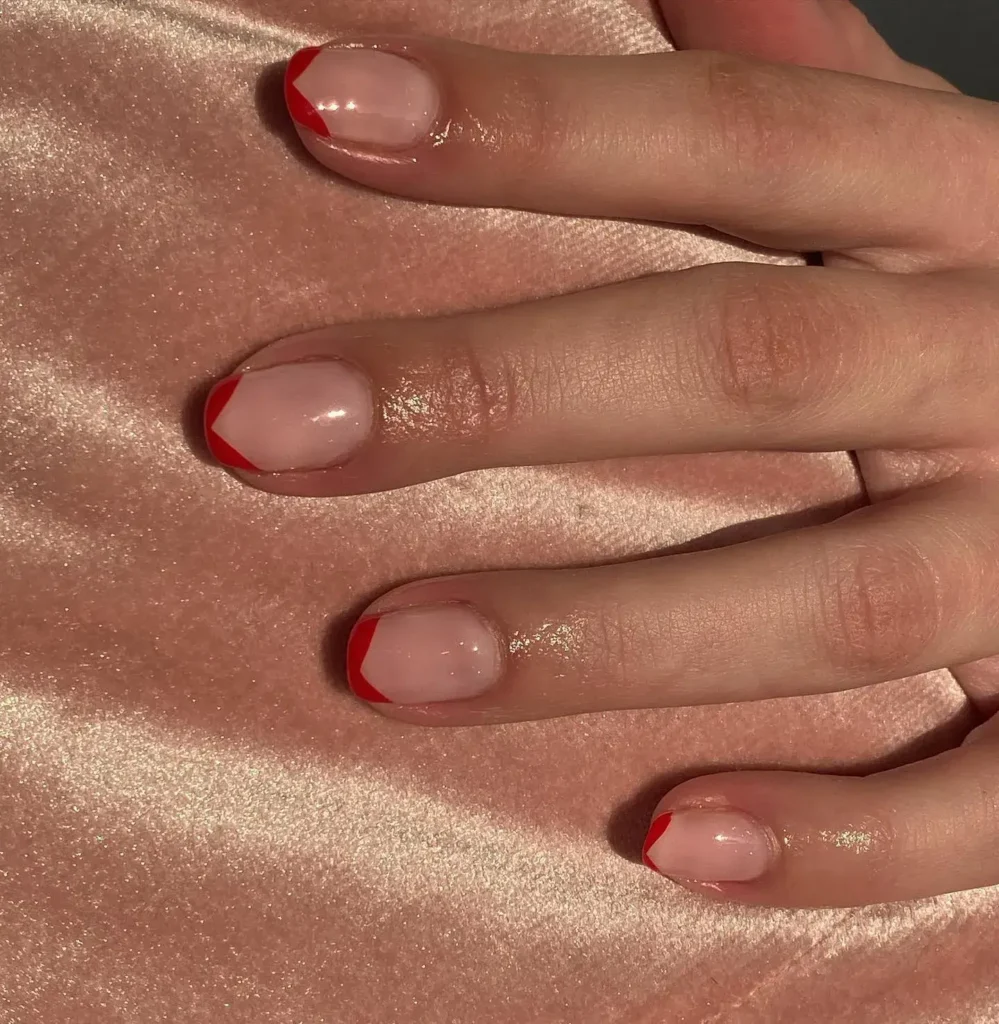
42. Chevron (V-Cut) French
Instead of a curved line, two straight diagonal lines meet at a sharp point in the center of the nail. This creates a V shape that draws the eye upward, and it reads as more structured than a traditional rounded tip.
43. Double Arches
Two separate curved lines run across the nail instead of one, creating a layered French effect. A thin strip of bare or sheer nail often shows between the two red bands.
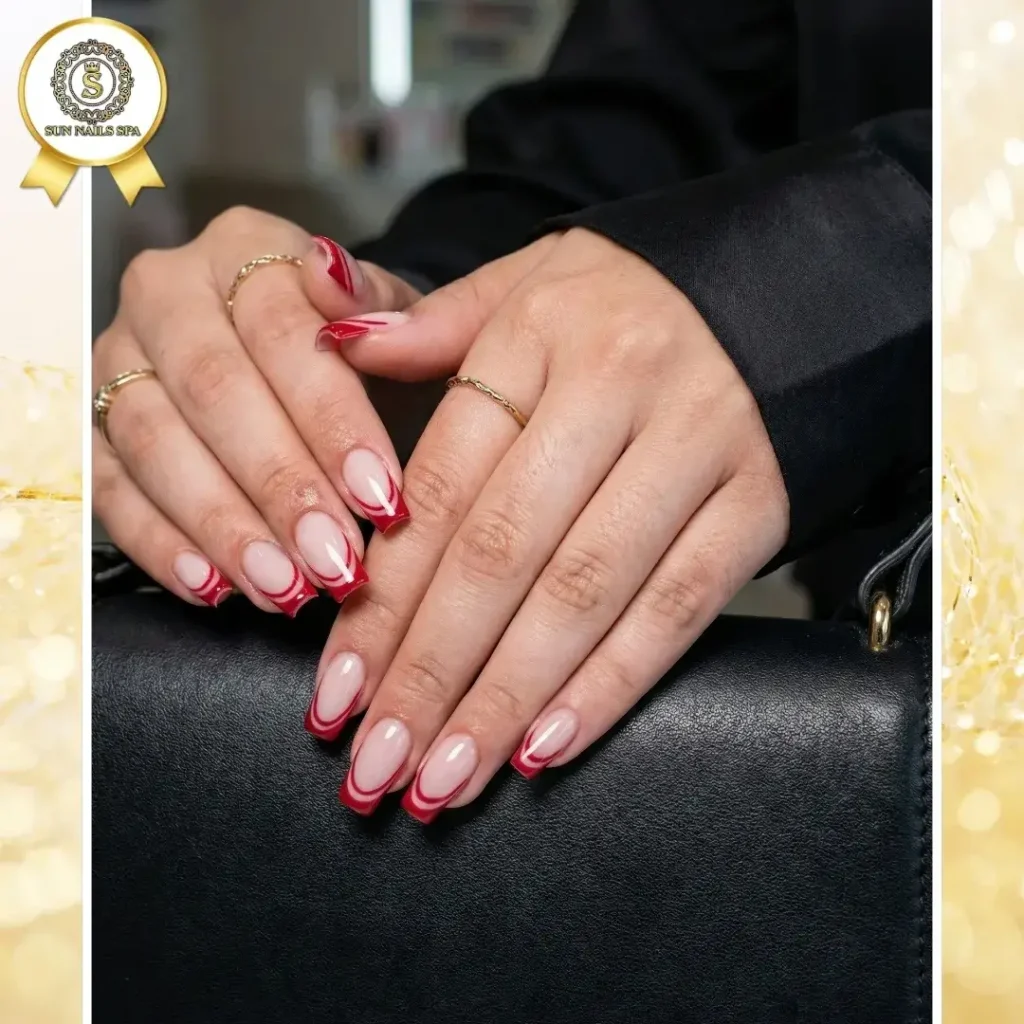
44. Negative Space French
Part of the nail is left completely bare, breaking up the usual full coverage of base plus tip. The red might appear only at the tip and along one side, with an open gap somewhere in between.
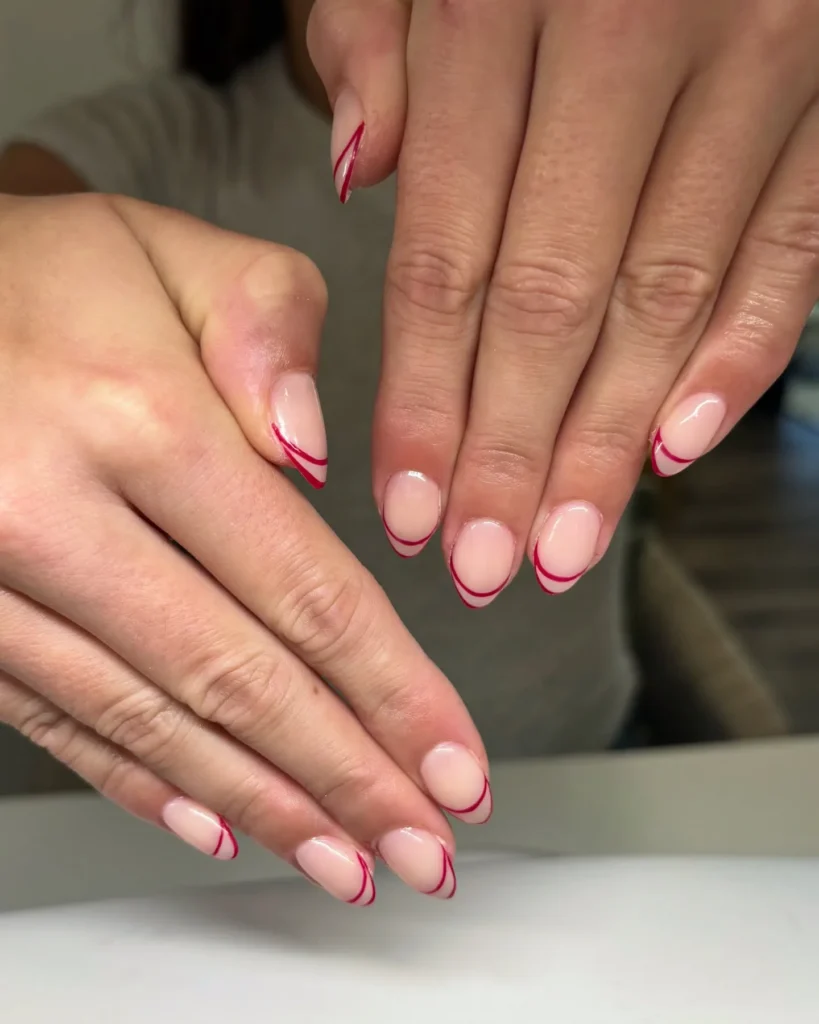
45. Asymmetrical Frenchies
The tip line is angled or shifted to one side instead of running evenly across the nail. Some versions look like the tip was cut on a diagonal, giving each nail a slightly different silhouette.
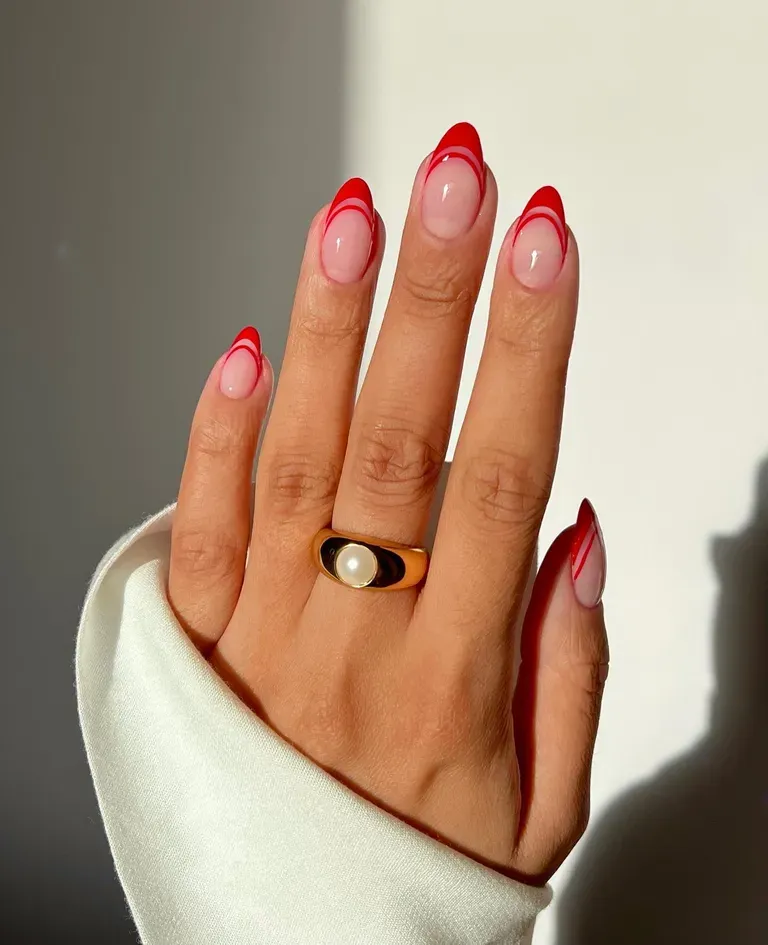
46. Abstract Tips
Red is applied in loose, irregular shapes rather than a defined line or curve. No two nails need to match exactly, which makes this version feel more artistic and less uniform than a standard French set.
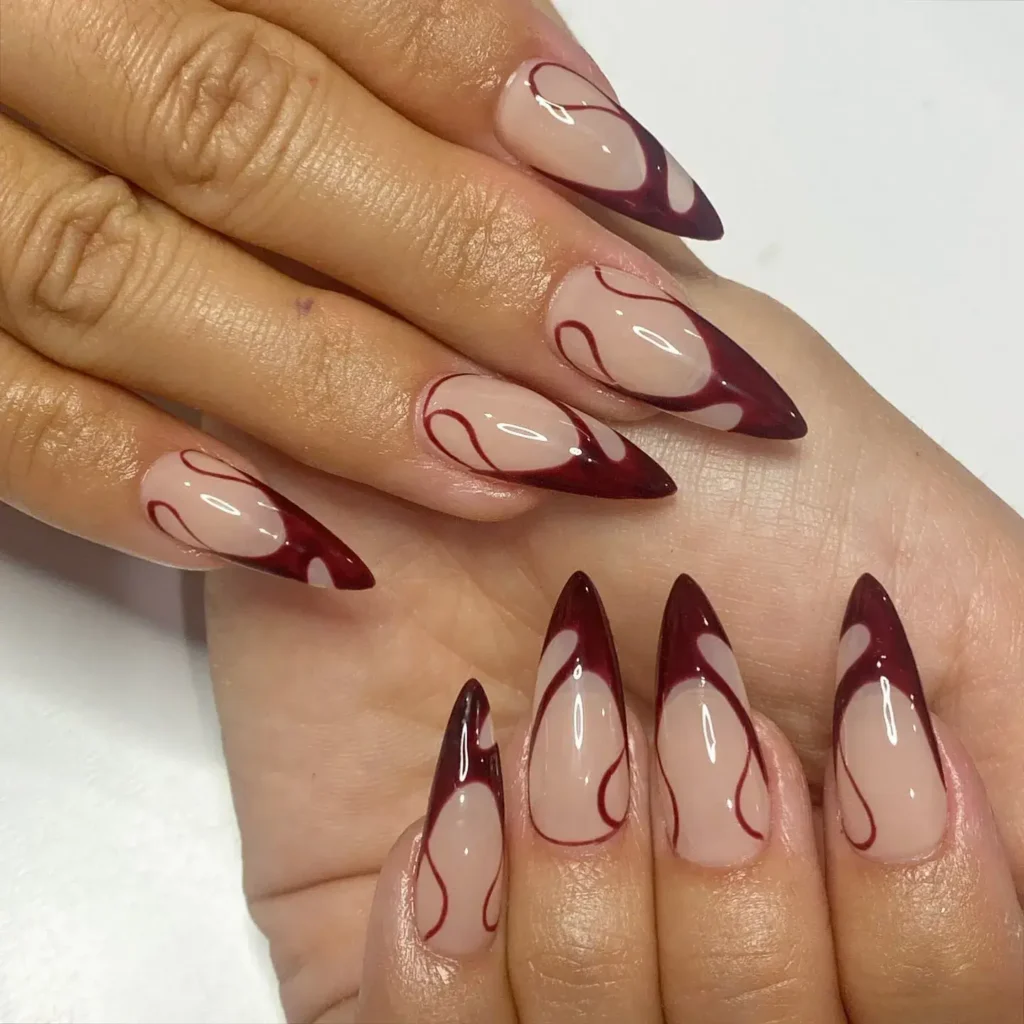
47. Red Flames
Flame shapes, pointed and tapering like fire, replace the usual straight or curved tip. The red is often placed at the base of the nail near the cuticle instead of at the tip, so the flame appears to rise up from the finger.
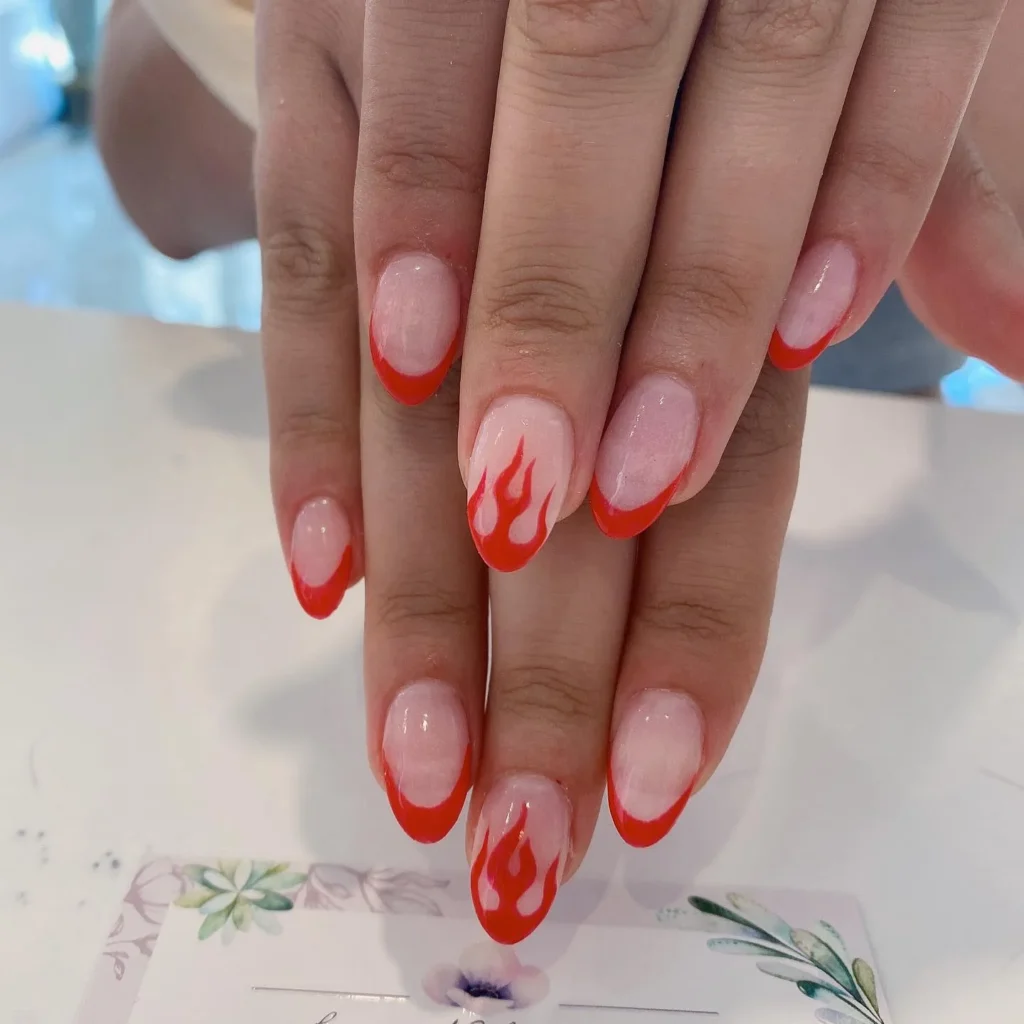
48. Blood Drip Tips
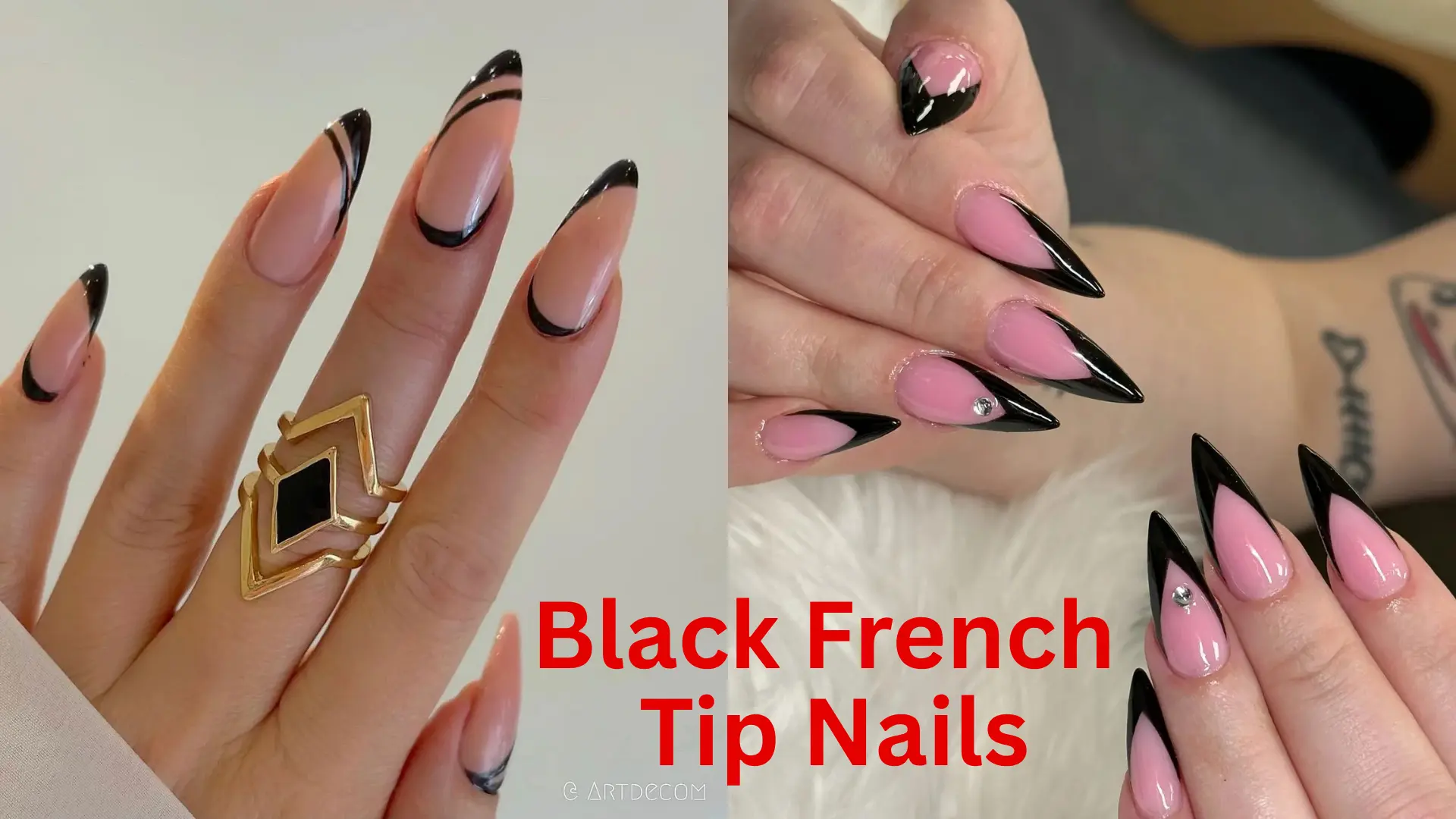
Red polish is painted to look like it’s dripping down from the tip toward the cuticle, with uneven, streaky edges instead of a clean line. It’s a common choice for Halloween or gothic-inspired sets. For an even moodier take, some dark and edgy French tip looks skip red altogether in favor of black.
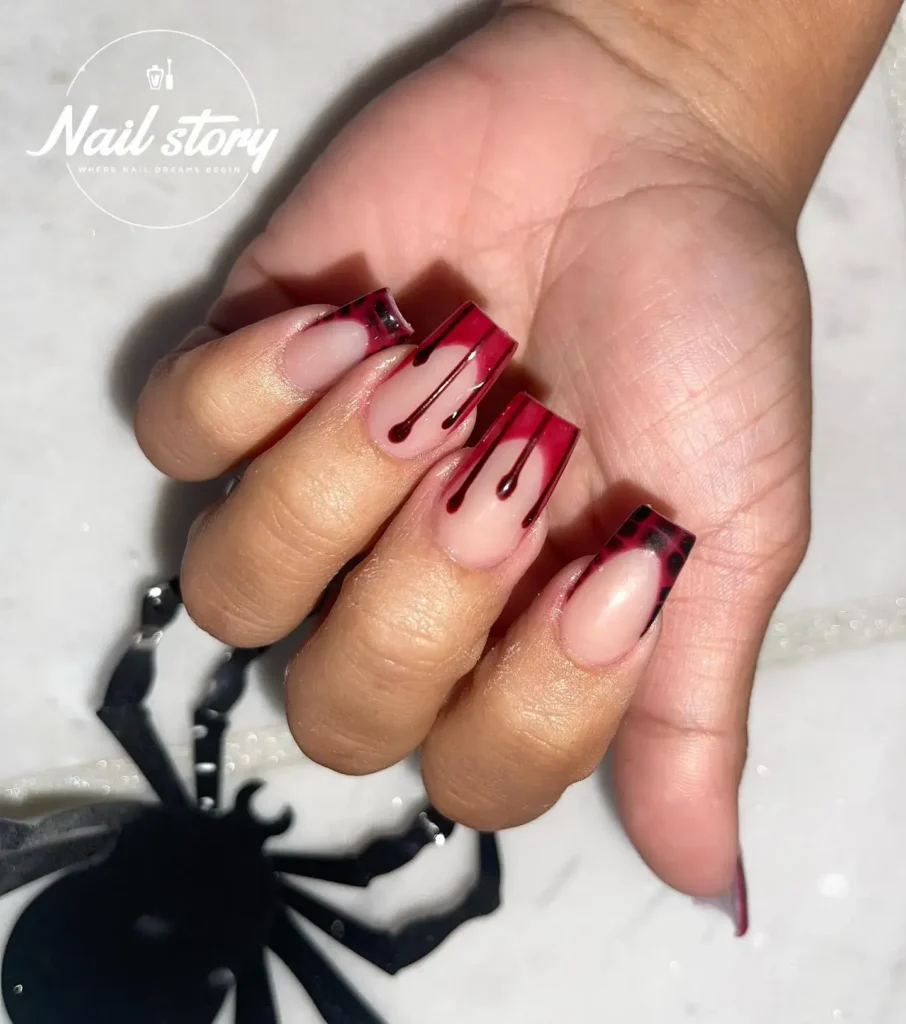
49. Swirly Shimmer
Red polish is swirled or marbled across part of the nail instead of applied as a flat block, often mixed with a shimmer or metallic polish. The result looks fluid, with no two swirls turning out exactly the same.
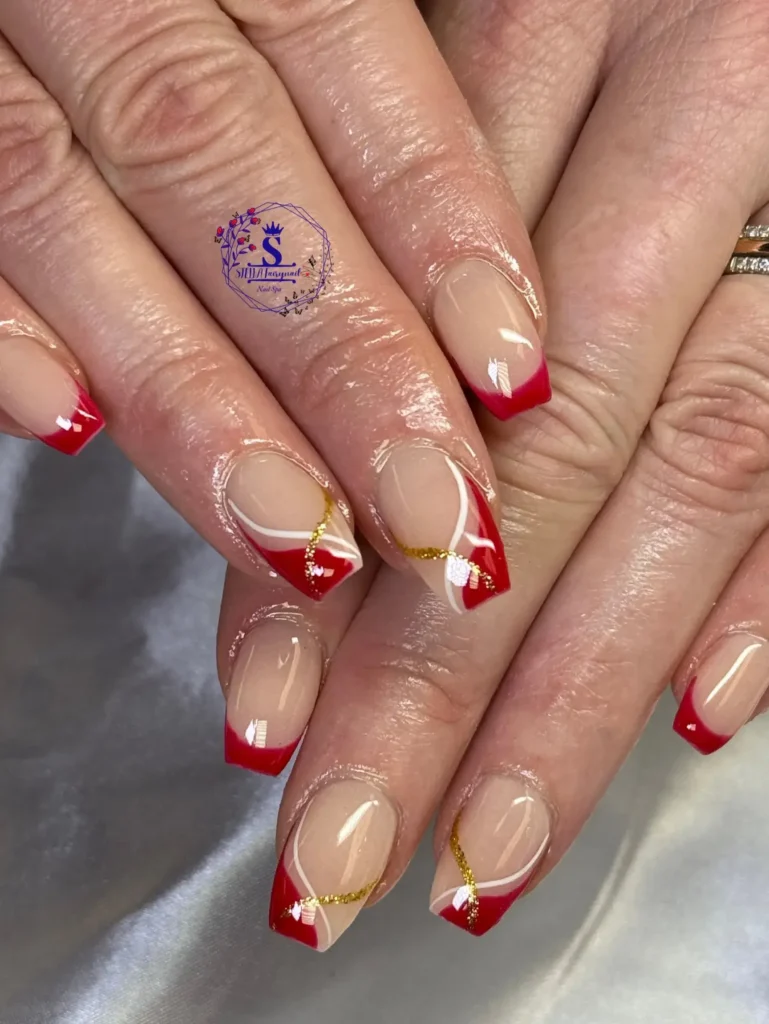
Gem, Pearl & Charm Embellished Red French Tip Nails
Five designs add dimensional embellishments, pearls, crystals, or small charms, on top of the red French tip base, giving the nail texture you can feel as well as see.
50. Pearl-Dotted French
Small pearl beads are placed along the smile line or scattered across the tip. Unlike flat rhinestones, pearls sit slightly raised off the nail surface, adding a soft, rounded texture to the design.
51. Heart Jewels
Heart-shaped crystals or charms replace the round rhinestones used in most embellished designs. A single heart jewel often sits at the base of the nail near the cuticle, or several are placed along the tip.
52. Chrome Rings
Small metallic ring charms, usually gold or silver, are pressed into the wet polish near the cuticle or along the side of the nail. The rings sit flat against the surface rather than adding much height, so they read as a subtle metallic accent rather than a full 3D charm.
53. Celestial French
Star and moon charms, or hand-painted celestial shapes, are placed on the tip or base alongside a red French tip. Some versions add a scattering of fine glitter to mimic a night sky behind the charms.
Red French Tips by Nail Shape
Nail shape changes how a red tip should be applied. These six designs match tip style to shape, so the French line works with the nail’s natural silhouette instead of against it.
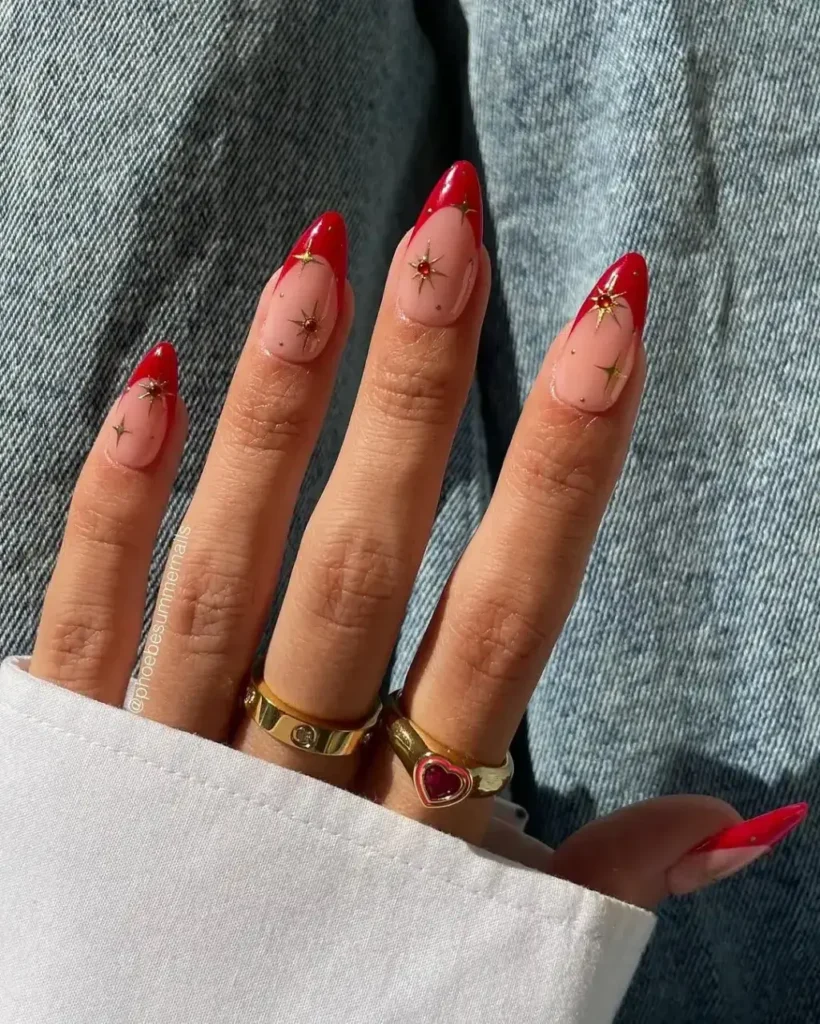
54. Almond Red French
The tip follows the nail’s tapered curve, sweeping up higher on the sides than in the center. This shape naturally elongates the finger, and a red tip that mirrors the curve adds to that effect rather than cutting across it.
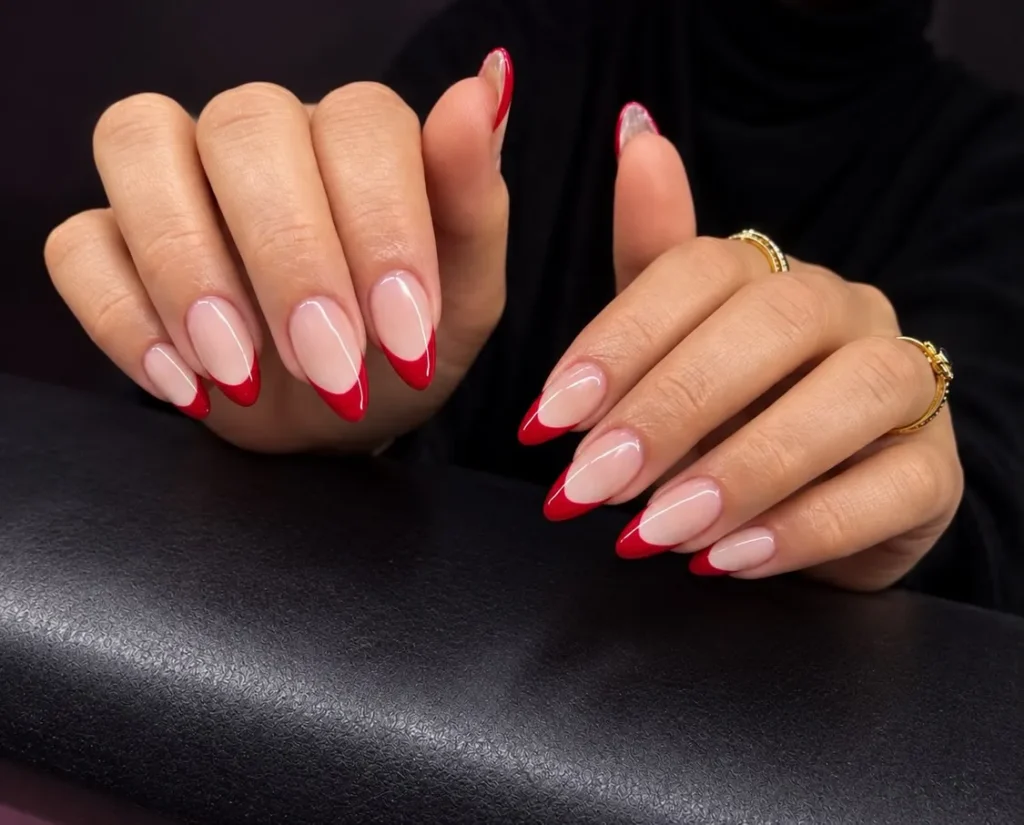
55. Square Red French
A straight, flat tip line matches the nail’s squared-off edge better than a curved one. Since square nails already read as bold, a thinner red line keeps the look balanced instead of heavy.
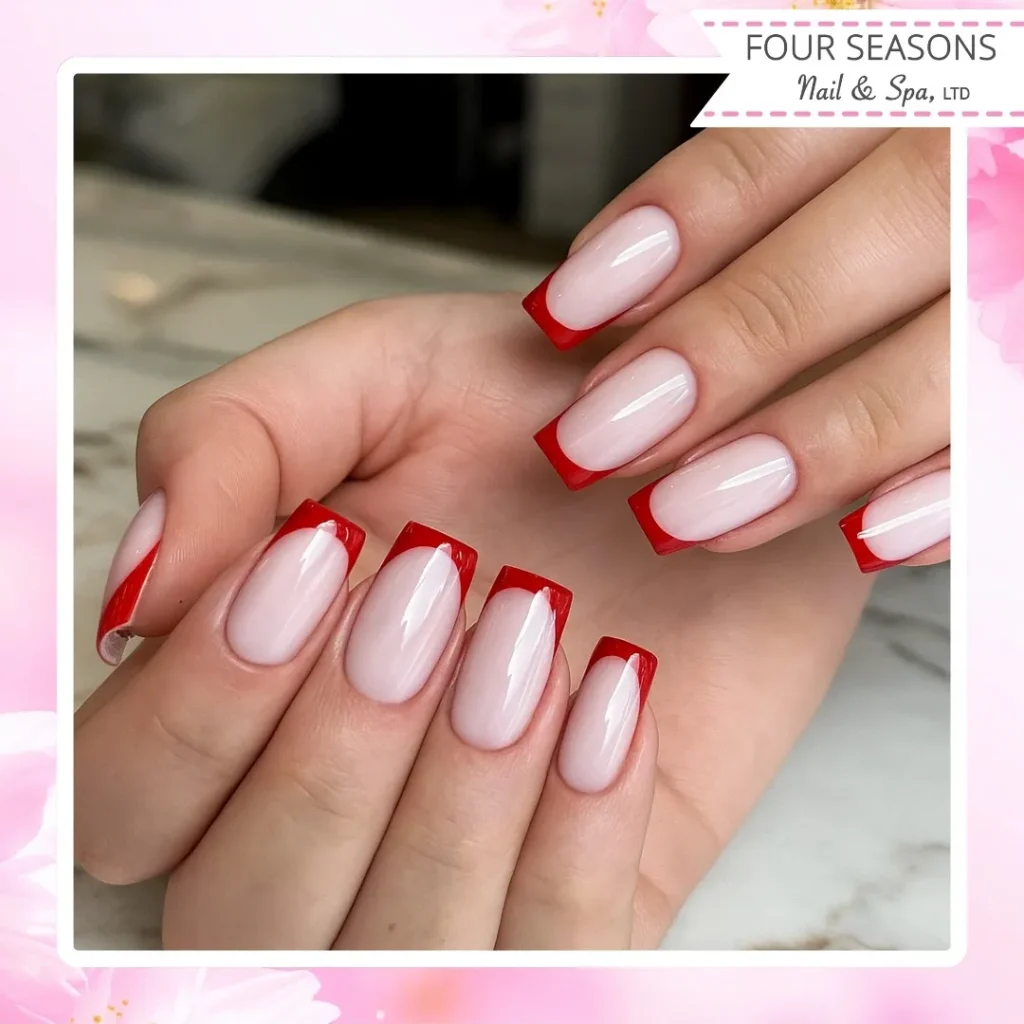
56. Coffin Red French
The wide, flat tip of a coffin nail gives more surface area to work with, which is why bolder styles like a V-cut or double French line up well here. A single thin line can look lost on this much nail space.
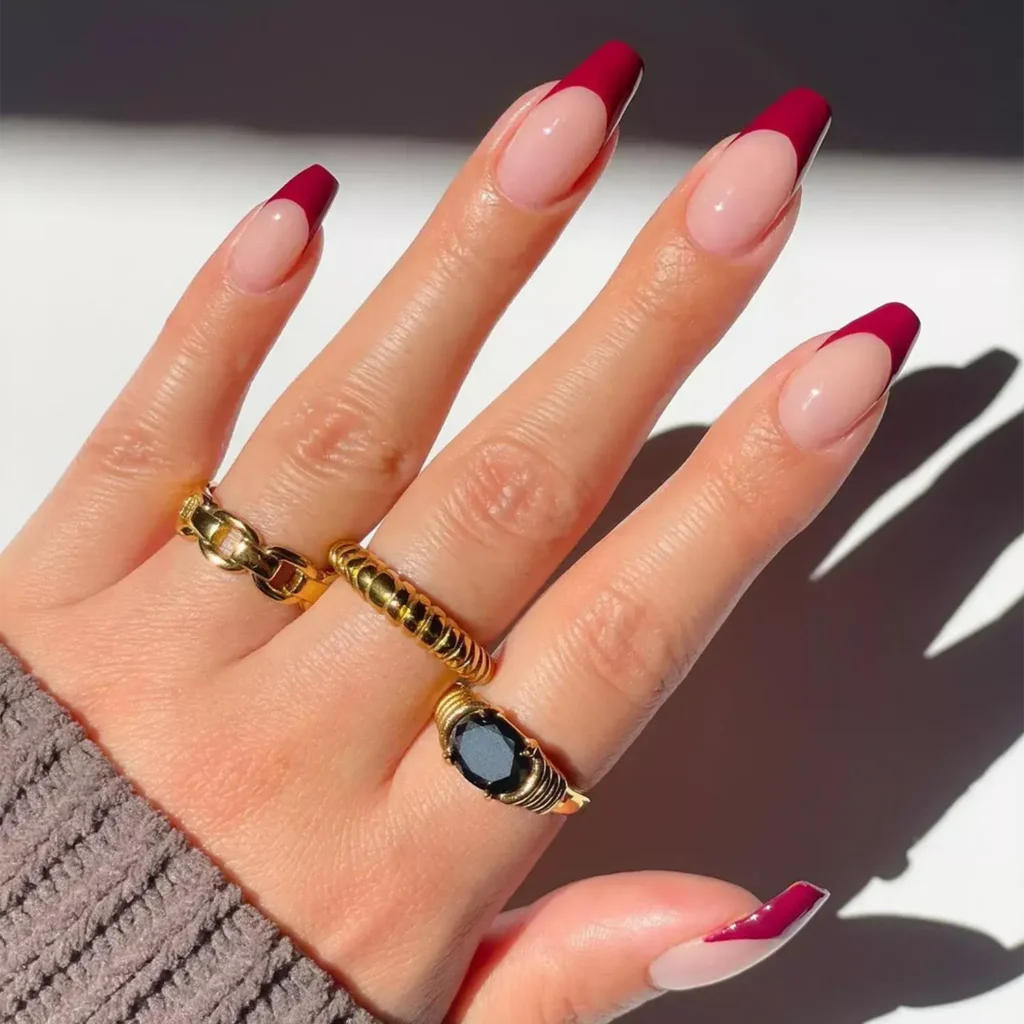
57. Stiletto Red French
The nail tapers to a sharp point, so tip styles that end in an angle, like a chevron or a drip design, follow that point naturally. A soft, rounded tip line looks out of place against such a sharp shape.
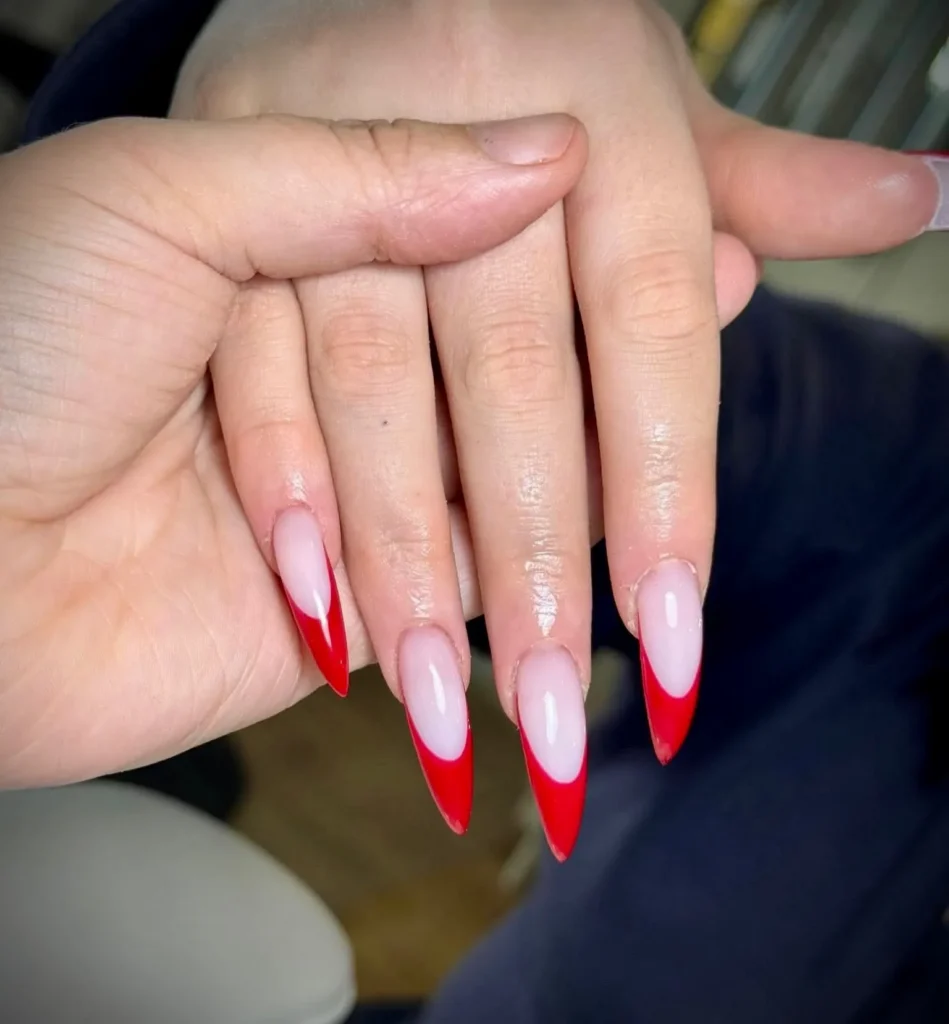
58. Oval Red French
Oval nails have a rounded tip with no flat edge or sharp point, which suits a soft, evenly curved French line. This shape works well with delicate styles like simple crescents or thin tips.
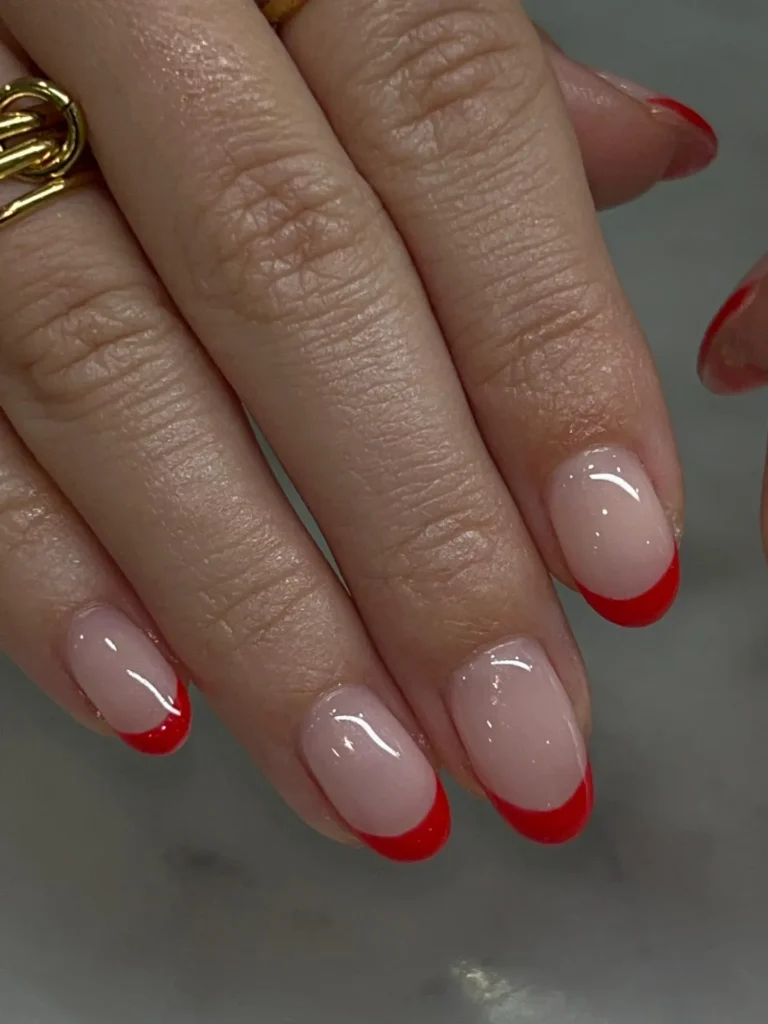
59. Short Micro-French
On shorter nails, a thin, hairline tip reads more clearly than a wide one, which can overwhelm the limited nail surface. A micro French keeps the proportions in check while still showing the red clearly. If you’re working with shorter nails overall, it’s worth browsing more short French tip nail designs before settling on tip width.
Seasonal & Occasion Red French Tip Nail Designs
Seven designs tie the red French tip to a specific holiday, season, or event, using small details that shift the style from everyday to occasion-specific.
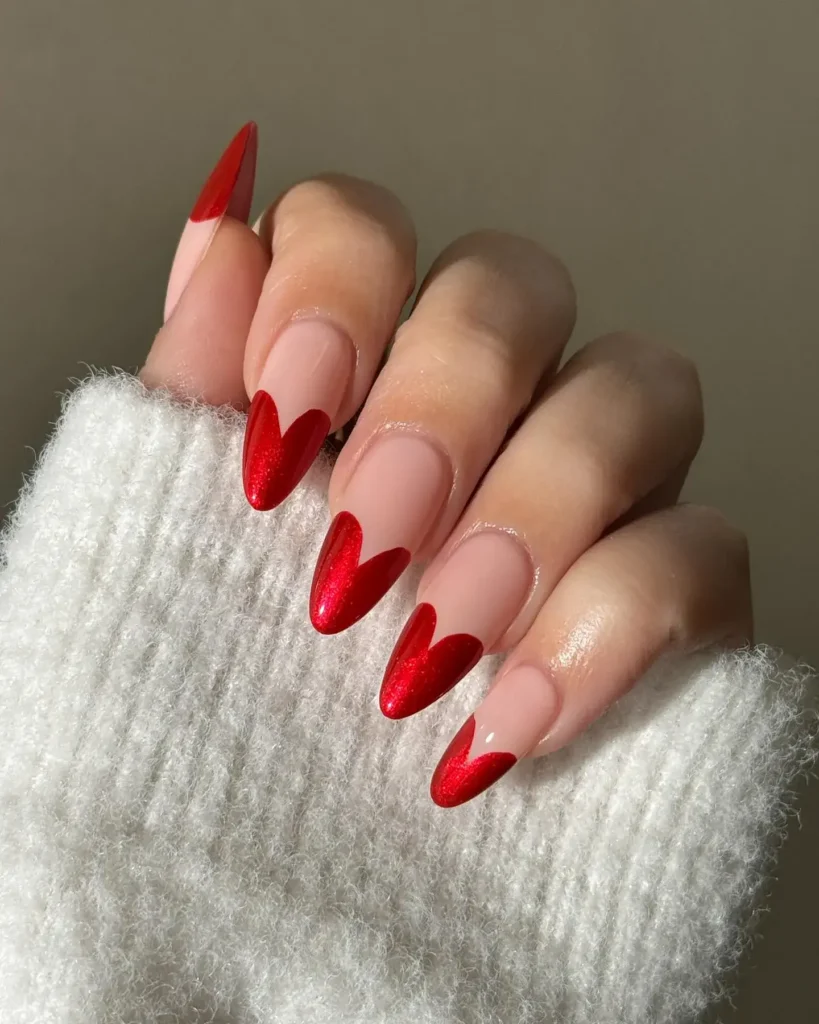
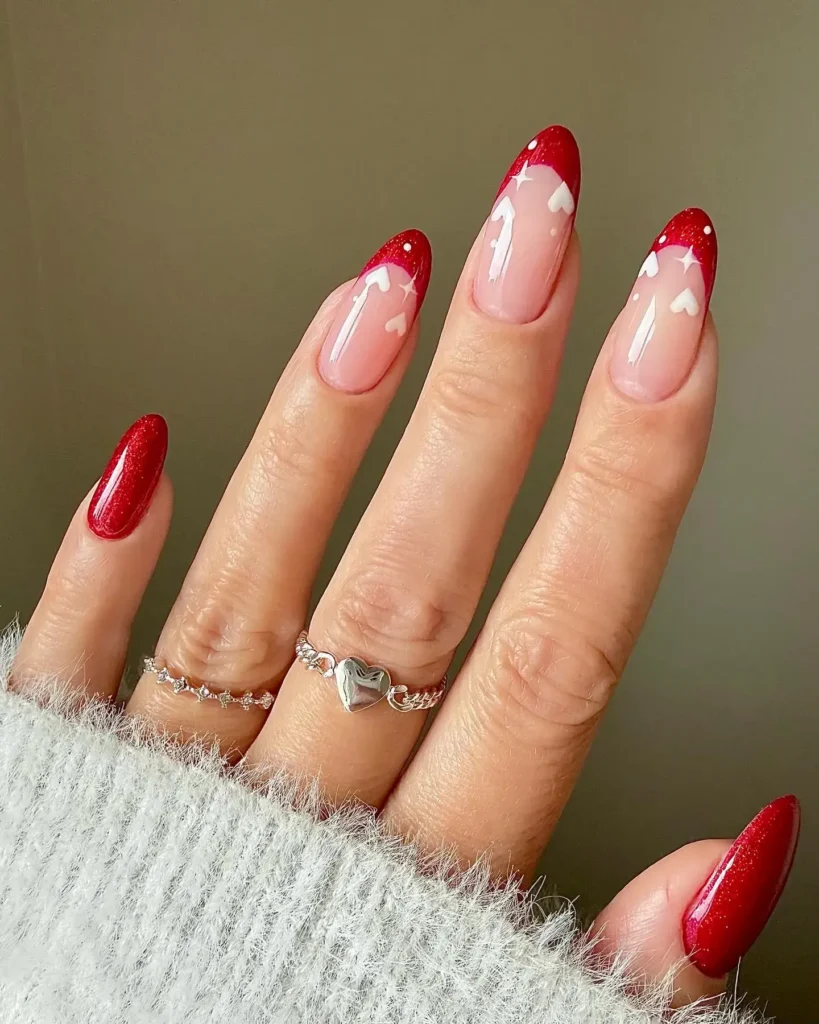
60. Valentine’s Day Heart French
The smile line is shaped into a heart instead of a curve or straight edge, with two rounded lobes meeting at a point in the center. Some versions keep the heart shape on every nail, while others use it only on one or two accent nails.
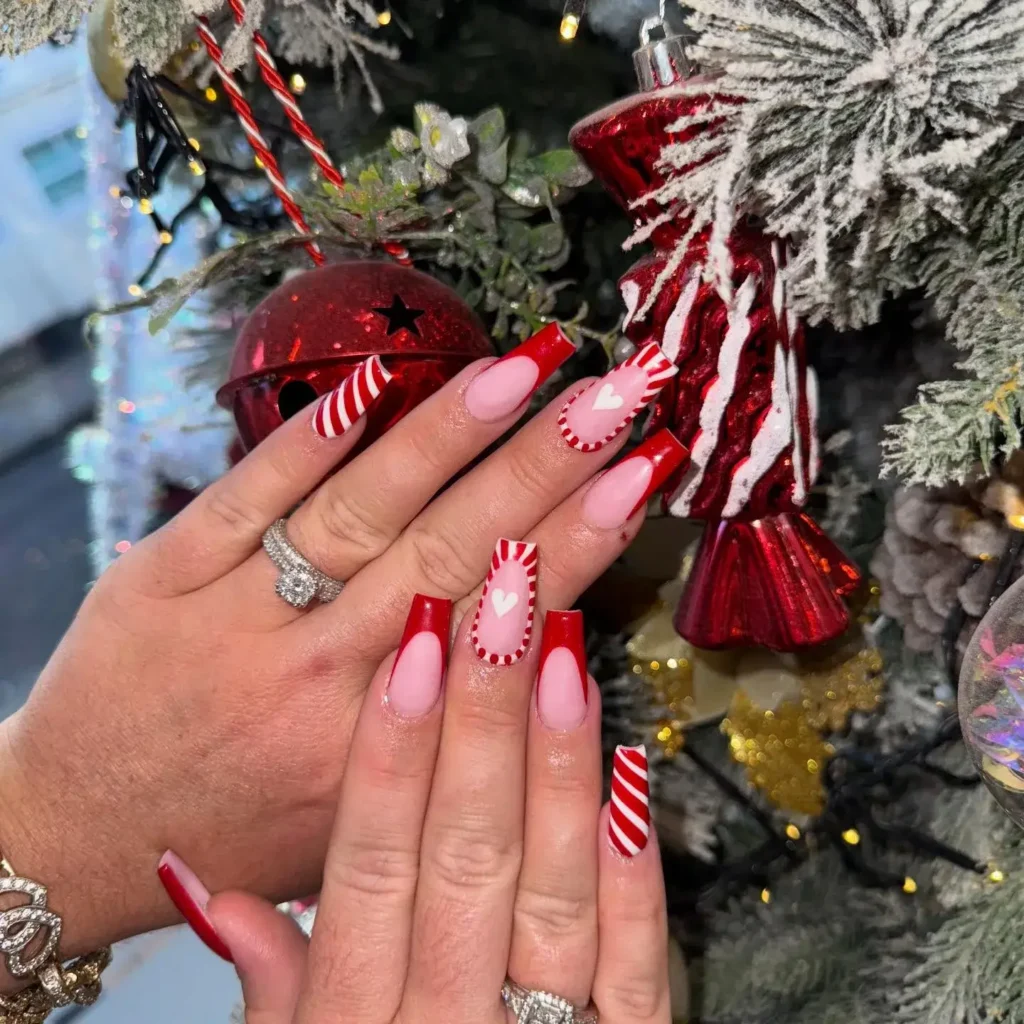
61. Candy Cane Stripes (Christmas)
Thin red and white stripes wrap around the tip, mimicking a candy cane pattern instead of a solid color block. It’s a direct, literal nod to the holiday rather than a subtler seasonal cue.
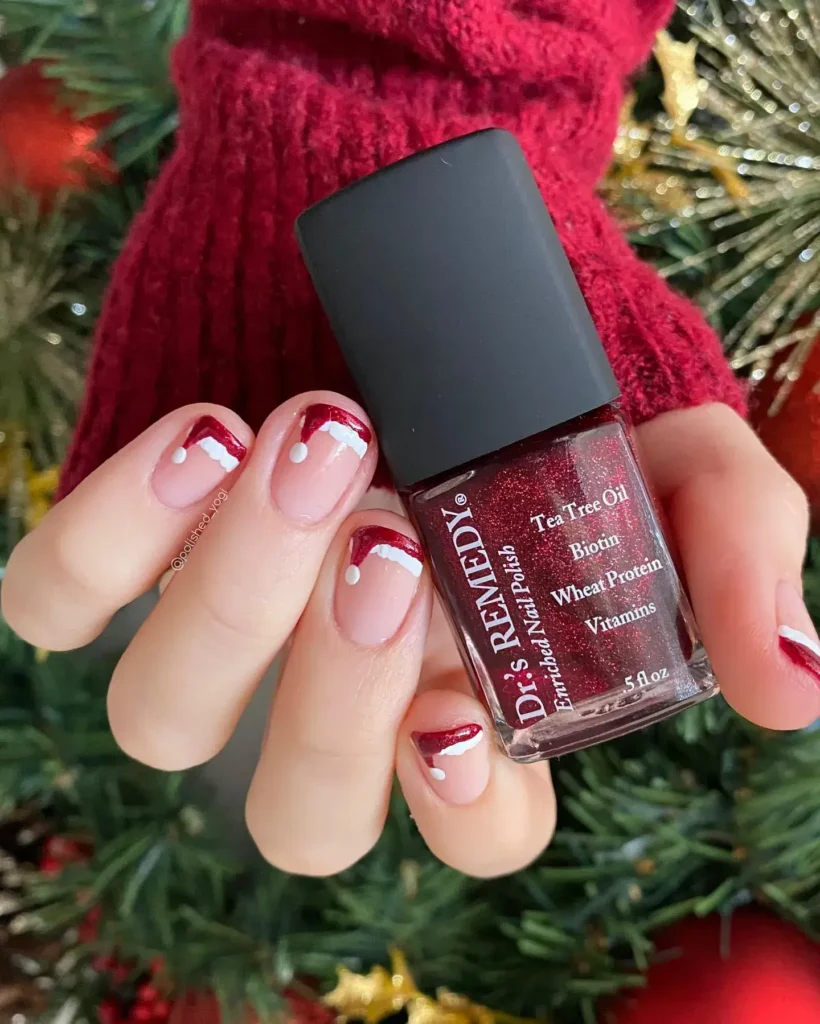
62. Santa Hat Tips (Christmas)
The tip is shaped and painted to resemble a small Santa hat, with a red base and a white, fluffy-looking edge along the top. This works best as an accent on one or two nails rather than across the whole set.
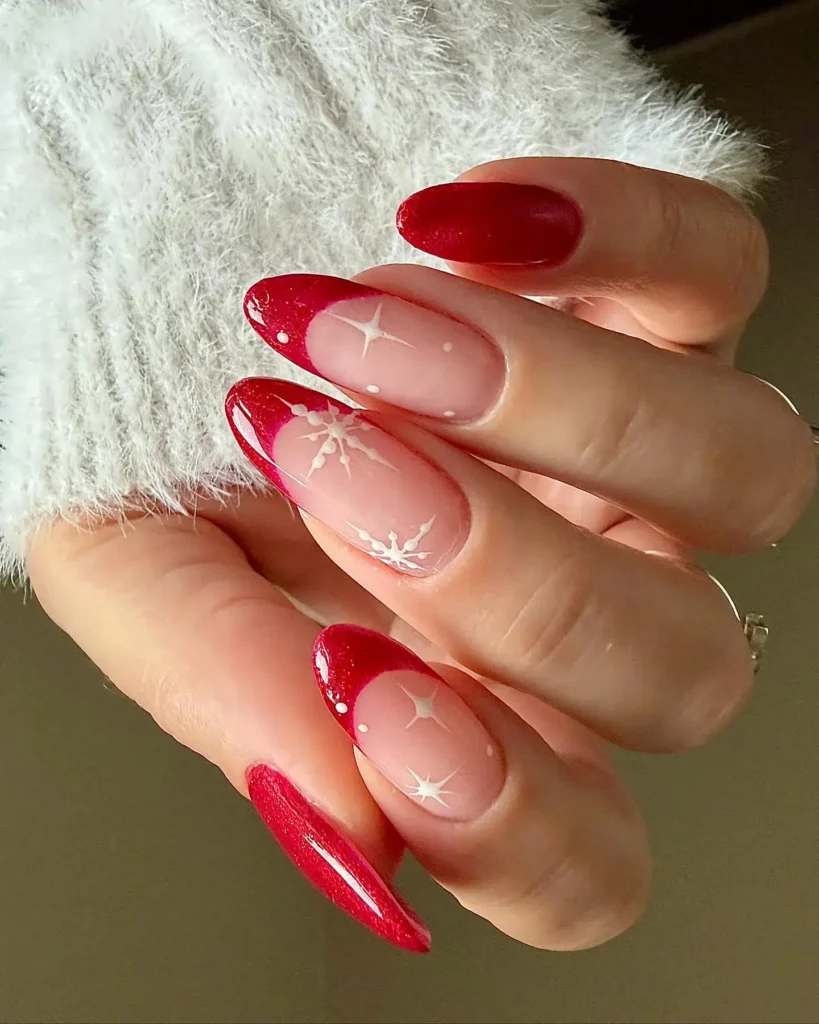
63. Snowflake Accents (Winter)
A small snowflake, usually painted in white, is added near the cuticle or center of the nail alongside a plain red French tip. It reads as winter-appropriate without being tied to one specific holiday.
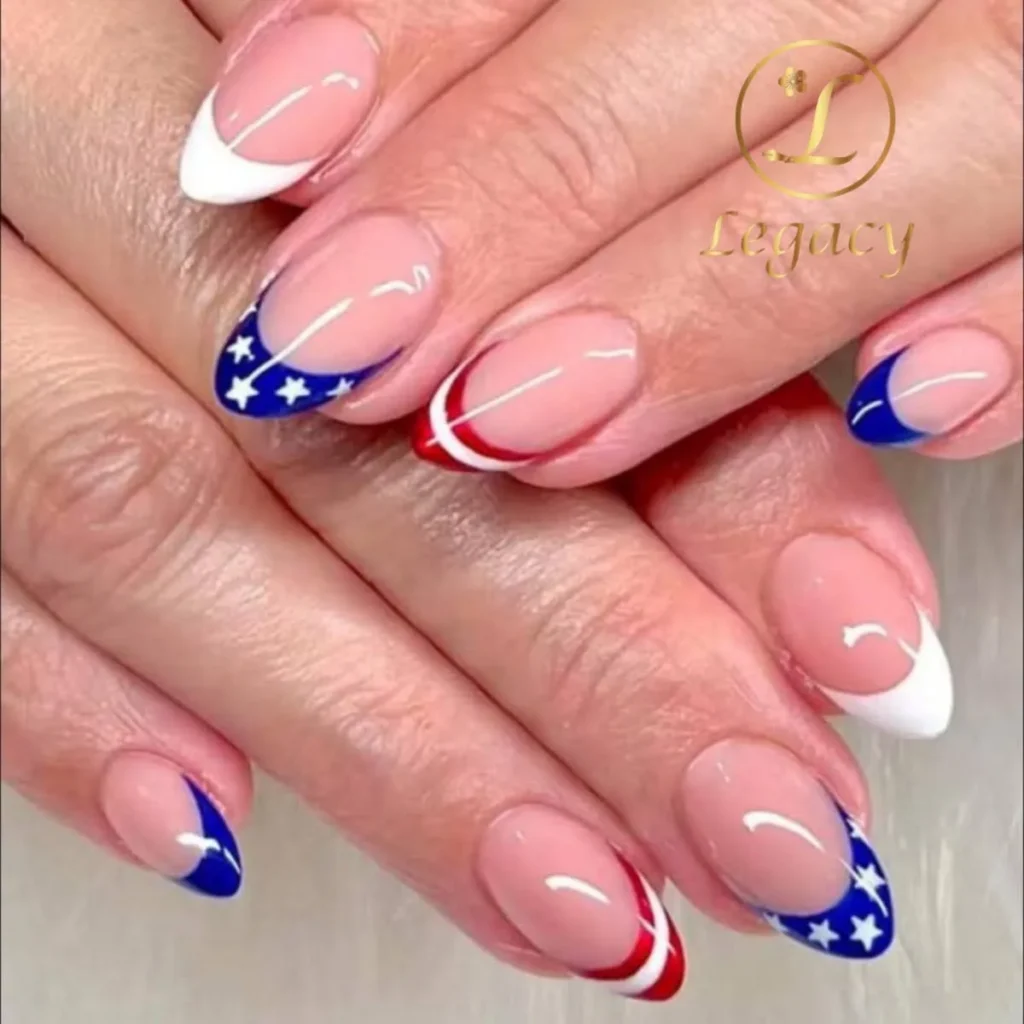
64. Americana Red, White and Blue French
Red, white, and blue French tips are combined across the set, either as alternating tip colors on different nails or as a red base with a blue and white accent nail. It’s built for Fourth of July and similar patriotic occasions.
65. Fall Tortoiseshell French
A hand-painted tortoiseshell pattern, warm ambers and deep browns blended together, covers part of the nail alongside a red or oxblood tip. The combination pulls the design toward autumn without relying on orange or leaf motifs.
Looking to build out a full autumn set beyond just the tips? Check out these seasonal fall-ready manicure ideas for more inspiration.
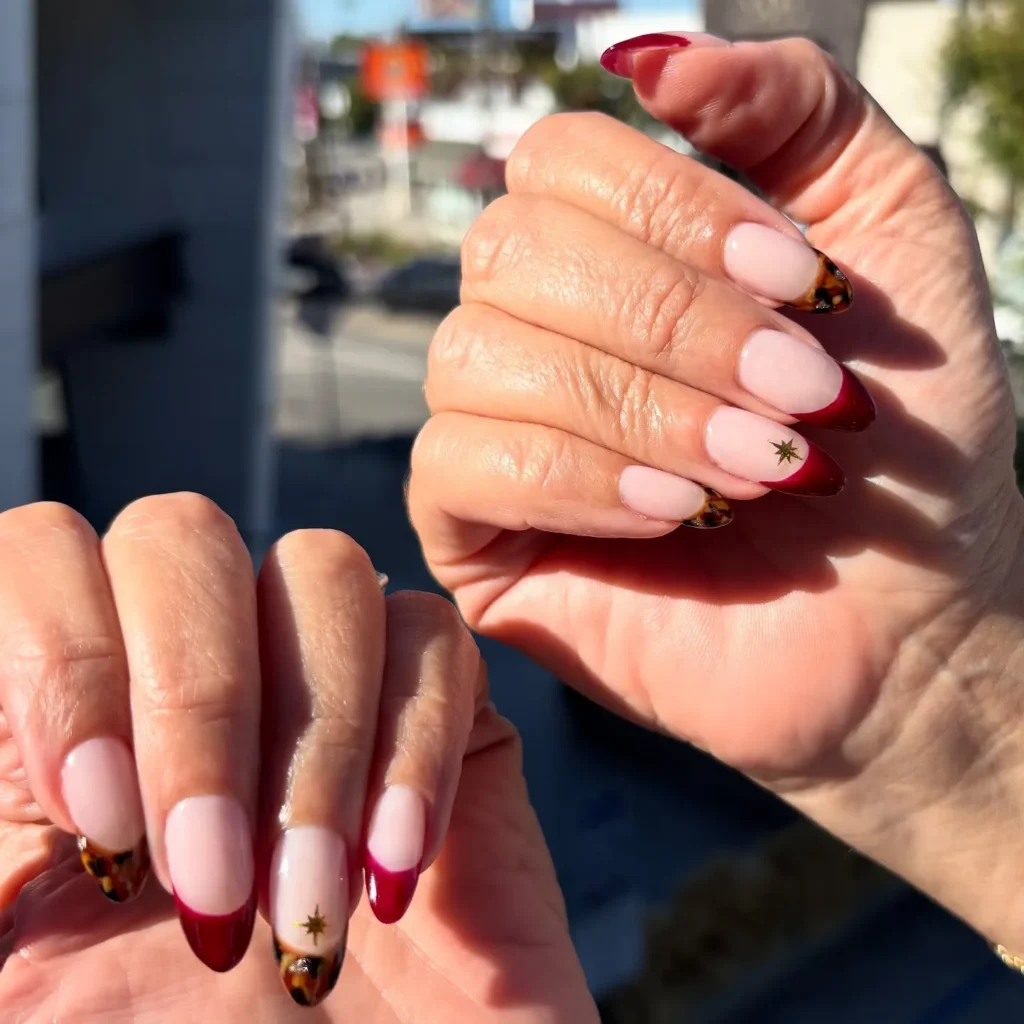
66. Wedding Day Red French
The design stays close to a classic red French tip, but with a cleaner, more refined finish, often paired with a glossy top coat and minimal extra detail. Some versions add a single small pearl or crystal instead of a full embellishment set.
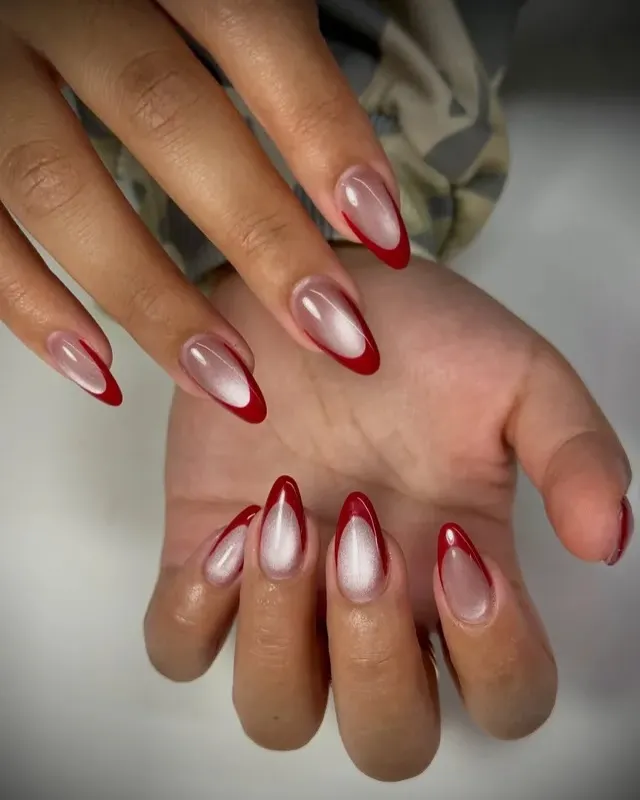
How to Choose Your Shade of Red
Not every red works the same way on every skin tone. Red polish splits into two main undertone families, and picking the wrong one can leave your hands looking washed out instead of polished.
Cool, Blue-Based Reds and Who They Flatter
Cherry, ruby, crimson, oxblood, and burgundy all carry a blue or violet undertone. These shades create contrast against warm, olive, or yellow-toned skin. That contrast brightens the hands and cuts down on any sallow or dull tone in the skin.
Warm, Orange-Based Reds and Who They Flatter
Poppy, tomato, and brick red lean toward orange and yellow. These shades blend well with warm, golden, or olive skin tones. On cool, pink-toned skin, though, they can look ruddy or make the hands seem washed out instead of warm.
True Reds That Work on Almost Everyone
A true, balanced red sits between the cool and warm families. It has enough blue and yellow mixed together that it doesn’t lean hard in either direction. This makes it the safest starting shade if you’re unsure which undertone suits you.
Why Your Red Might Be Reading Orange
If a red polish looks more orange than red once it’s on, a few things are usually at play. Warm lighting can shift how the color reads. A yellow-toned top coat can also pull a true red toward orange. And a red with a warm undertone will always look more orange on skin with cool, pink tones, no matter how it looks in the bottle. If this keeps happening, try switching to a blue-based red instead.
Milky, Sheer, or Clear: Choosing Your Base
The base color under your red tip changes the whole look, and it’s one of the most debated parts of this design.
A milky white or pale pink base gives the nail a soft, opaque look and hides any unevenness in the natural nail bed. Some people find this base makes the skin look lighter or slightly washed out by comparison.
A sheer, natural pink base lets more of your real nail show through. It reads as more skin-like and tends to blend better with a wider range of skin tones, since it’s not adding an extra layer of white or pink on top.
A completely clear base skips color altogether. This shows the most of your natural nail, including any ridges or discoloration, so it works best on nails that are already in good condition.
There’s no single correct choice here. If you want the cleanest, most opaque look, go milky. If you want the base to disappear and let your skin tone lead, go sheer or clear.
Are Red French Tips Classy or Trashy?
It depends on execution, not the color itself.
Red nail theory is a viral TikTok idea claiming red nails read as more confident and get noticed more. There’s no science behind it, just personal stories, so some people find it true, others think it’s overstated.
What actually decides classy vs. trashy: nail shape, tip width, base color, and finish. A short, glossy, well-shaped tip reads as polished. A long, thick tip with a sloppy smile line looks messy in any color.
To keep it “old money” rather than costume-y: go short to medium length, rounded or almond shape, a clean symmetrical smile line, and stick to one shade of red with no extra color or embellishment.
How to Do Red French Tips at Home
You don’t need a salon to get a clean red French tip, but the technique takes some patience.
What You Need
- A base coat
- A sheer or nude polish for the base, if you’re not going bare
- A red polish or gel in your chosen shade
- A thin nail art brush or a French tip guide sticker
- A top coat
- A small brush or cotton swab dipped in polish remover for cleanup
Step-by-Step Application
- Shape and buff your nails, then apply a base coat.
- If you want a nude or sheer base color, apply that first and let it dry fully.
- Using a thin brush or a guide sticker, paint the red tip. Start at the center of the nail tip and pull the line outward toward each side to keep the curve even.
- Clean up any smudges along the edges with a small brush dipped in polish remover before the color dries.
- Let the red fully dry, then seal everything with a top coat, making sure to cap the free edge of the nail.
Common Mistakes to Avoid
- Applying the red in one thick coat instead of two thin ones, which can cause streaking or an uneven finish.
- Skipping the top coat over the tip’s edge, which leaves the color more likely to chip.
- Rushing the smile line, which is the easiest part of the design to get lopsided.
- Using a red polish or gel without a base coat first, which can stain the natural nail underneath.
Frequently Asked Questions
Are red French tips still in style in 2026?
Yes. Red French tips have grown alongside two larger trends, the ongoing French manicure revival and red nail theory, and searches for the style have stayed strong rather than dropping off after a single season. Chrome, cat-eye, and glitter finishes have kept the design feeling current rather than dated.
What nail color is most attractive?
This is subjective, and there’s no single answer that holds true for everyone. Red gets cited most often, largely because of red nail theory, but attractiveness in nail color depends on personal style, skin tone, and context as much as the shade itself.
What nail color makes you look younger?
Softer, muted shades tend to be linked with a younger look more than dark or very saturated colors, though this varies by individual and by how the color is applied. A well-shaped, glossy red French tip in a brighter or true red tends to read as fresher than a deep, matte, or overly thick application.
How do I keep a reverse French manicure from chipping?
The tip and cuticle line take the most daily wear, so seal both edges fully with top coat, including the very edge of the nail. Reapplying a thin layer of top coat every few days extends wear, and gel formulas generally hold up longer than regular polish for this style.